

Ch.20 - Electrochemistry
Brown - Chemistry: The Central Science 14th Edition
Brown14th EditionChemistry: The Central ScienceISBN: 9780134414232Non è quello che usi tu?Cambia libro di testo
Capitolo 20, Problema 52c

For each of the following reactions, write a balanced equation, calculate the standard emf, calculate ∆G° at 298 K, and calculate the equilibrium constant K at 298 K. (c) In basic solution, Cr1OH231s2 is oxidized to CrO42-1aq2 by ClO-1aq2.

Guida verificata passo dopo passo
1
Step 1: Write the balanced redox reaction.
Step 2: Calculate the standard cell potential (E°cell) using standard reduction potentials.
Step 3: Use the Nernst equation to calculate the standard Gibbs free energy change (∆G°) at 298 K.
Step 4: Use the relationship between ∆G° and the equilibrium constant (K) to calculate K at 298 K.
Step 5: Verify the balanced equation and calculations for consistency and accuracy.

Risposta video verificata per un problema simile:

Questa soluzione video è stata consigliata dai nostri tutor come utile per risolvere questo problema.
Durata del video:
18m

Concetti chiave

Ecco i concetti essenziali che devi comprendere per rispondere correttamente alla domanda.

Balancing Redox Reactions

Balancing redox reactions involves ensuring that the number of atoms and the charge are equal on both sides of the equation. This process often requires identifying the oxidation and reduction half-reactions, balancing them separately, and then combining them to form a complete balanced equation. In this case, understanding the oxidation states of chromium in Cr(OH)2 and CrO4^2- is essential.
Video consigliato:
Percorso guidato
01:04
Balancing Basic Redox Reactions

Standard Electromotive Force (emf)

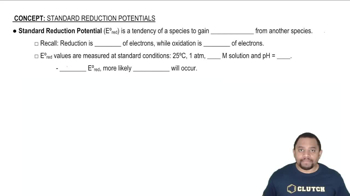
The standard electromotive force (emf) of a reaction is the voltage produced by an electrochemical cell under standard conditions. It can be calculated using the standard reduction potentials of the half-reactions involved. A positive emf indicates a spontaneous reaction, while a negative emf suggests non-spontaneity. This concept is crucial for determining the feasibility of the redox reaction in question.
Video consigliato:
Percorso guidato
01:10
Standard Reduction Potentials

Gibbs Free Energy and Equilibrium Constant

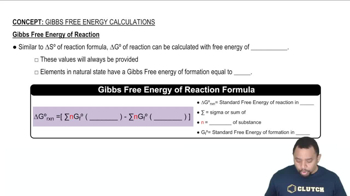
Gibbs free energy (∆G°) is a thermodynamic quantity that indicates the spontaneity of a reaction at constant temperature and pressure. The relationship between ∆G° and the equilibrium constant (K) is given by the equation ∆G° = -RT ln(K), where R is the gas constant and T is the temperature in Kelvin. This relationship allows for the calculation of K from ∆G° and vice versa, providing insight into the position of equilibrium for the reaction.
Video consigliato:
Percorso guidato
01:51
Gibbs Free Energy of Reactions