
Ch.20 - Electrochemistry
Brown - Chemistry: The Central Science 14th Edition
Brown14th EditionChemistry: The Central ScienceISBN: 9780134414232Non è quello che usi tu?Cambia libro di testo
Capitolo 20, Problema 100c

Gold exists in two common positive oxidation states, +1 and +3. The standard reduction potentials for these oxidation states are Au+1aq2 + e- ¡ Au1s2 Ered ° = +1.69 V Au3+1aq2 + 3 e- ¡ Au1s2 Ered ° = +1.50 V (c) Miners obtain gold by soaking gold-containing ores in an aqueous solution of sodium cyanide. A very soluble complex ion of gold forms in the aqueous solution because of the redox reaction 4 Au1s2 + 8 NaCN1aq2 + 2 H2O1l2 + O21g2 ¡ 4 Na3Au1CN2241aq2 + 4 NaOH1aq2 What is being oxidized, and what is being reduced in this reaction?

Guida verificata passo dopo passo
1
Identify the oxidation states of gold in the reactants and products. In the reactants, gold (Au) is in its elemental form, which has an oxidation state of 0. In the products, gold is part of the complex ion Na3Au(CN)4, where it typically has an oxidation state of +1.
Determine the change in oxidation state for gold. Gold goes from an oxidation state of 0 in the reactants to +1 in the products, indicating that gold is being oxidized.
Identify the other elements involved in the reaction. Oxygen (O2) is present in the reactants and is typically in the 0 oxidation state. In the products, it is part of NaOH, where it has an oxidation state of -2.
Determine the change in oxidation state for oxygen. Oxygen goes from an oxidation state of 0 in O2 to -2 in NaOH, indicating that oxygen is being reduced.
Conclude that in this redox reaction, gold (Au) is being oxidized, and oxygen (O2) is being reduced.

Risposta video verificata per un problema simile:

Questa soluzione video è stata consigliata dai nostri tutor come utile per risolvere questo problema.
Durata del video:
5m

Concetti chiave

Ecco i concetti essenziali che devi comprendere per rispondere correttamente alla domanda.

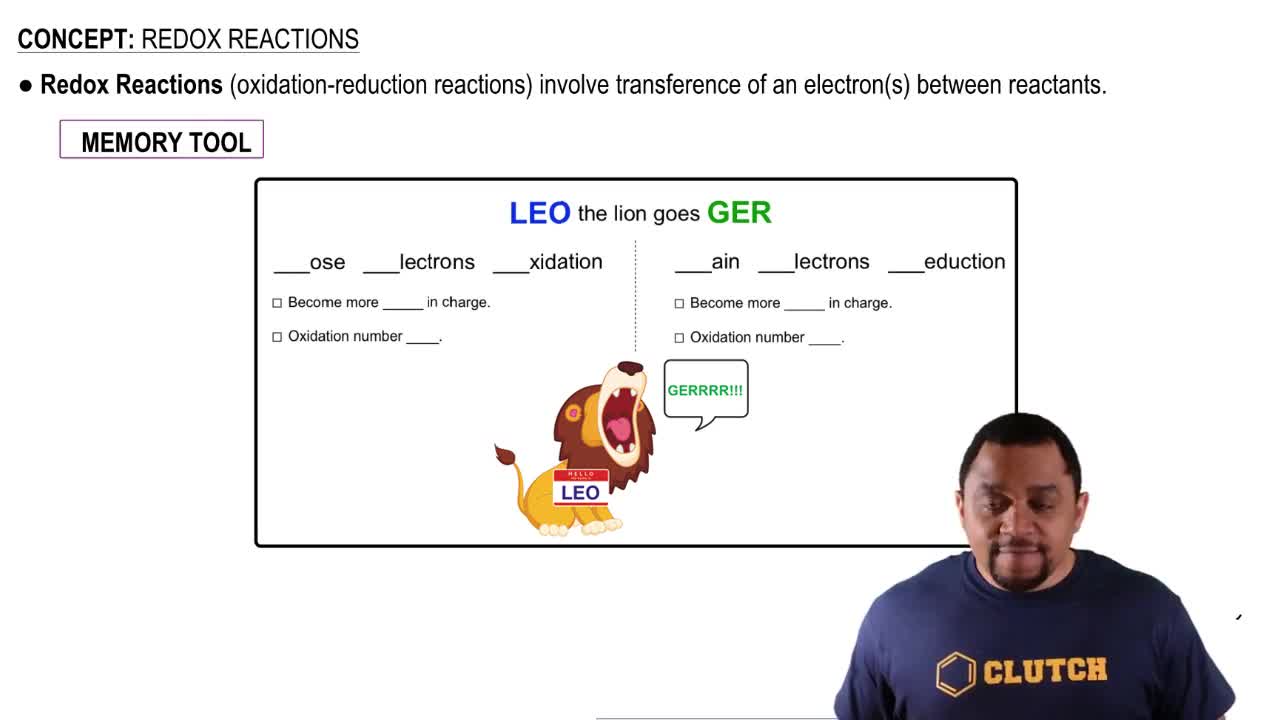
Oxidation and Reduction

Oxidation and reduction are chemical processes that involve the transfer of electrons between species. Oxidation refers to the loss of electrons, resulting in an increase in oxidation state, while reduction involves the gain of electrons, leading to a decrease in oxidation state. In redox reactions, one species is oxidized and another is reduced, which is essential for understanding the overall reaction.
Video consigliato:
Percorso guidato
01:53
Oxidation and Reduction Reactions

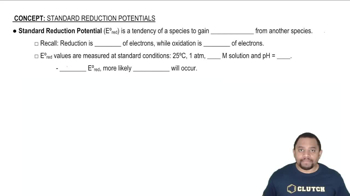
Standard Reduction Potentials

Standard reduction potentials (E°) are measures of the tendency of a chemical species to be reduced, expressed in volts. A higher E° value indicates a greater likelihood of reduction occurring. In the context of the given question, comparing the E° values of Au+1 and Au3+ helps determine which species is more likely to be reduced during the reaction, guiding the identification of oxidized and reduced components.
Video consigliato:
Percorso guidato
01:10
Standard Reduction Potentials

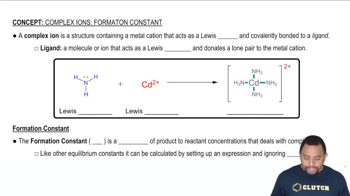
Complex Ion Formation

Complex ions are formed when metal ions coordinate with ligands, which are molecules or ions that can donate electron pairs. In the reaction involving gold and sodium cyanide, the formation of the complex ion Na3Au(CN)2 illustrates how gold ions interact with cyanide ligands. Understanding this concept is crucial for analyzing the overall redox process and the stability of the resulting complex in solution.
Video consigliato:
Percorso guidato
02:20
Complex Ions and Formation Constant