
Gold exists in two common positive oxidation states, +1 and +3. The standard reduction potentials for these oxidation states are Au+1aq2 + e- ¡ Au1s2 Ered ° = +1.69 V Au3+1aq2 + 3 e- ¡ Au1s2 Ered ° = +1.50 V (c) Miners obtain gold by soaking gold-containing ores in an aqueous solution of sodium cyanide. A very soluble complex ion of gold forms in the aqueous solution because of the redox reaction 4 Au1s2 + 8 NaCN1aq2 + 2 H2O1l2 + O21g2 ¡ 4 Na3Au1CN2241aq2 + 4 NaOH1aq2 What is being oxidized, and what is being reduced in this reaction?
Ch.20 - Electrochemistry
Brown14th EditionChemistry: The Central ScienceISBN: 9780134414232Non è quello che usi tu?Cambia libro di testo
Capitolo 20, Problema 99
Predict whether the following reactions will be spontaneous in acidic solution under standard conditions: (a) oxidation of Sn to Sn2+ by I2 (to form I-), (b) reduction of Ni2+ to Ni by I- (to form I2), (c) reduction of Ce4+ to Ce3+ by H2O2, (d) reduction of Cu2+ to Cu by Sn2+ (to form Sn4+).
Guida verificata passo dopo passo1
Identify the half-reactions involved in the process. For the reduction of Ce^{4+} to Ce^{3+}, the half-reaction is: Ce^{4+} + e^- \(\rightarrow\) Ce^{3+}. For the oxidation of H_2O_2, the half-reaction is: H_2O_2 \(\rightarrow\) O_2 + 2H^+ + 2e^-.
Look up the standard reduction potentials (E^\(\circ\)) for each half-reaction. The standard reduction potential for Ce^{4+} to Ce^{3+} is E^\(\circ\)_{Ce^{4+}/Ce^{3+}}. The standard reduction potential for the reverse of the oxidation of H_2O_2 (i.e., O_2 to H_2O_2) is E^\(\circ\)_{O_2/H_2O_2}.
Calculate the standard cell potential (E^\(\circ\)_{cell}) by using the formula: E^\(\circ\)_{cell} = E^\(\circ\)_{reduction} - E^\(\circ\)_{oxidation}. Here, E^\(\circ\)_{reduction} is the potential for Ce^{4+}/Ce^{3+} and E^\(\circ\)_{oxidation} is the potential for H_2O_2/O_2.
Determine the spontaneity of the reaction. If E^\(\circ\)_{cell} > 0, the reaction is spontaneous under standard conditions. If E^\(\circ\)_{cell} < 0, the reaction is non-spontaneous.
Consider the effect of acidic conditions on the reaction. Since the problem specifies acidic solution, ensure that the half-reactions are balanced with respect to H^+ ions and electrons.

Risposta video verificata per un problema simile:
Questa soluzione video è stata consigliata dai nostri tutor come utile per risolvere questo problema.
Durata del video:
7mConcetti chiave
Ecco i concetti essenziali che devi comprendere per rispondere correttamente alla domanda.
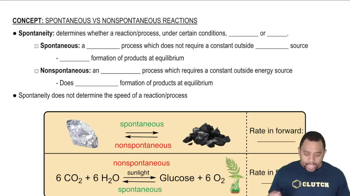
Spontaneity of Reactions
A reaction is considered spontaneous if it occurs without external intervention, typically determined by the change in Gibbs free energy (ΔG). If ΔG is negative, the reaction is spontaneous under the given conditions. Understanding spontaneity involves evaluating thermodynamic parameters and the reaction's enthalpy and entropy changes.
Video consigliato:
Percorso guidato
Spontaneity of Processes
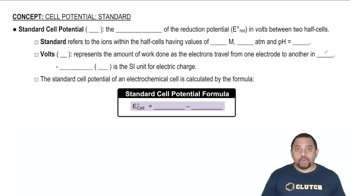
Standard Electrode Potentials
Standard electrode potentials (E°) are measured under standard conditions and indicate the tendency of a species to be reduced or oxidized. A higher E° value suggests a greater likelihood of reduction. For redox reactions, comparing the E° values of the involved half-reactions helps predict the spontaneity of the overall reaction.
Video consigliato:
Percorso guidato
Standard Cell Potential
Acidic Solution Effects
In an acidic solution, the concentration of hydrogen ions (H+) affects the equilibrium of redox reactions. The presence of H+ can shift the reaction's position, influencing the reduction potential of certain species. This is particularly relevant for reactions involving transition metals or complex ions, where pH can significantly alter the reaction dynamics.
Video consigliato:
Percorso guidato
Common Ion Effect in Acids and Bases
Pratica correlata
Domanda del libro di testo
1870
views
Domanda del libro di testo
A disproportionation reaction is an oxidation–reduction reaction in which the same substance is oxidized and reduced. Complete and balance the following disproportionation reactions:
(b) MnO42-(aq) → MnO4-(aq) + MnO2(s) (acidic solution)
1228
views
