Ch.20 - Electrochemistry
Brown - Chemistry: The Central Science 14th Edition
Brown14th EditionChemistry: The Central ScienceISBN: 9780134414232Non è quello che usi tu?Cambia libro di testo
Capitolo 20, Problema 54

If the equilibrium constant for a one-electron redox reaction at 298 K is 8.7 * 10^4, calculate the corresponding ∆G° and E°.

Guida verificata passo dopo passo
1
Step 1: Recall the relationship between the equilibrium constant (K) and the standard Gibbs free energy change (∆G°) using the equation: ∆G° = -RT ln(K), where R is the universal gas constant (8.314 J/mol·K) and T is the temperature in Kelvin.
Step 2: Substitute the given values into the equation: R = 8.314 J/mol·K, T = 298 K, and K = 8.7 * 10^4. Calculate the natural logarithm of K, ln(8.7 * 10^4).
Step 3: Calculate ∆G° by substituting the values of R, T, and ln(K) into the equation ∆G° = -RT ln(K).
Step 4: Use the relationship between ∆G° and the standard cell potential (E°) for a redox reaction: ∆G° = -nFE°, where n is the number of moles of electrons transferred (n = 1 for a one-electron reaction) and F is the Faraday constant (96485 C/mol).
Step 5: Rearrange the equation to solve for E°: E° = -∆G°/(nF). Substitute the calculated value of ∆G° and the constants n and F to find E°.

Concetti chiave

Ecco i concetti essenziali che devi comprendere per rispondere correttamente alla domanda.

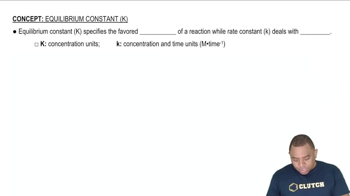
Equilibrium Constant (K)

The equilibrium constant (K) quantifies the ratio of the concentrations of products to reactants at equilibrium for a reversible reaction. In redox reactions, a higher K value indicates a greater tendency for the reaction to proceed in the forward direction, favoring product formation. This constant is crucial for calculating thermodynamic properties like Gibbs free energy and cell potential.
Video consigliato:
Percorso guidato
01:14
Equilibrium Constant K

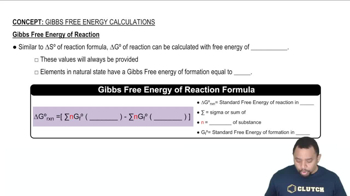
Gibbs Free Energy (∆G°)

Gibbs free energy (∆G°) is a thermodynamic potential that indicates the spontaneity of a reaction at constant temperature and pressure. It is related to the equilibrium constant by the equation ∆G° = -RT ln(K), where R is the universal gas constant and T is the temperature in Kelvin. A negative ∆G° suggests that the reaction is spontaneous under standard conditions.
Video consigliato:
Percorso guidato
01:51
Gibbs Free Energy of Reactions

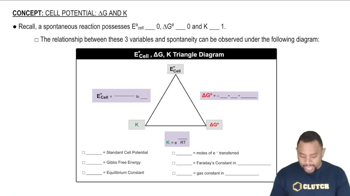
Electrode Potential (E°)

Electrode potential (E°) is a measure of the tendency of a chemical species to be reduced, expressed in volts. It is related to the Gibbs free energy change by the equation ∆G° = -nFE°, where n is the number of moles of electrons transferred and F is Faraday's constant. A positive E° indicates a favorable reaction, while a negative E° suggests non-spontaneity.
Video consigliato:
Percorso guidato
02:43
Relationship between ∆E°, ∆G°, and K