
Ch.20 - Electrochemistry
Brown - Chemistry: The Central Science 14th Edition
Brown14th EditionChemistry: The Central ScienceISBN: 9780134414232Non è quello che usi tu?Cambia libro di testo
Capitolo 20, Problema 78b

In some applications nickel–cadmium batteries have been replaced by nickel–zinc batteries. The overall cell reaction for this relatively new battery is: 2 H2O(l) + 2 NiO(OH)(s) + Zn(s) → 2 Ni(OH)2(s) + Zn(OH)2(s) (b) What is the anode half-reaction?

Guida verificata passo dopo passo
1
Identify the reactants and products in the overall cell reaction to determine the changes occurring at each electrode.
Recognize that the anode is where oxidation occurs in a battery. Oxidation involves the loss of electrons.
Examine the overall reaction to find which reactant loses electrons. In this case, zinc (Zn) starts as a solid and ends up in a compound, indicating it likely undergoes oxidation.
Write the oxidation half-reaction for zinc. Start with the elemental form of zinc and show its transformation into its oxidized form, incorporating the appropriate number of electrons to balance the reaction.
Balance the half-reaction for mass and charge, ensuring the number of atoms and the electrical charges are equal on both sides of the equation.

Risposta video verificata per un problema simile:

Questa soluzione video è stata consigliata dai nostri tutor come utile per risolvere questo problema.
Durata del video:
8m

Concetti chiave

Ecco i concetti essenziali che devi comprendere per rispondere correttamente alla domanda.

Half-Reactions

Half-reactions are the individual reactions that occur at the anode and cathode in an electrochemical cell. They represent the oxidation and reduction processes separately. In the context of batteries, the anode half-reaction involves the loss of electrons, while the cathode half-reaction involves the gain of electrons. Understanding half-reactions is crucial for analyzing the overall cell reaction.
Video consigliato:
Percorso guidato
01:49
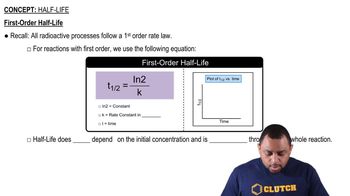
First-Order Half-Life

Oxidation and Reduction

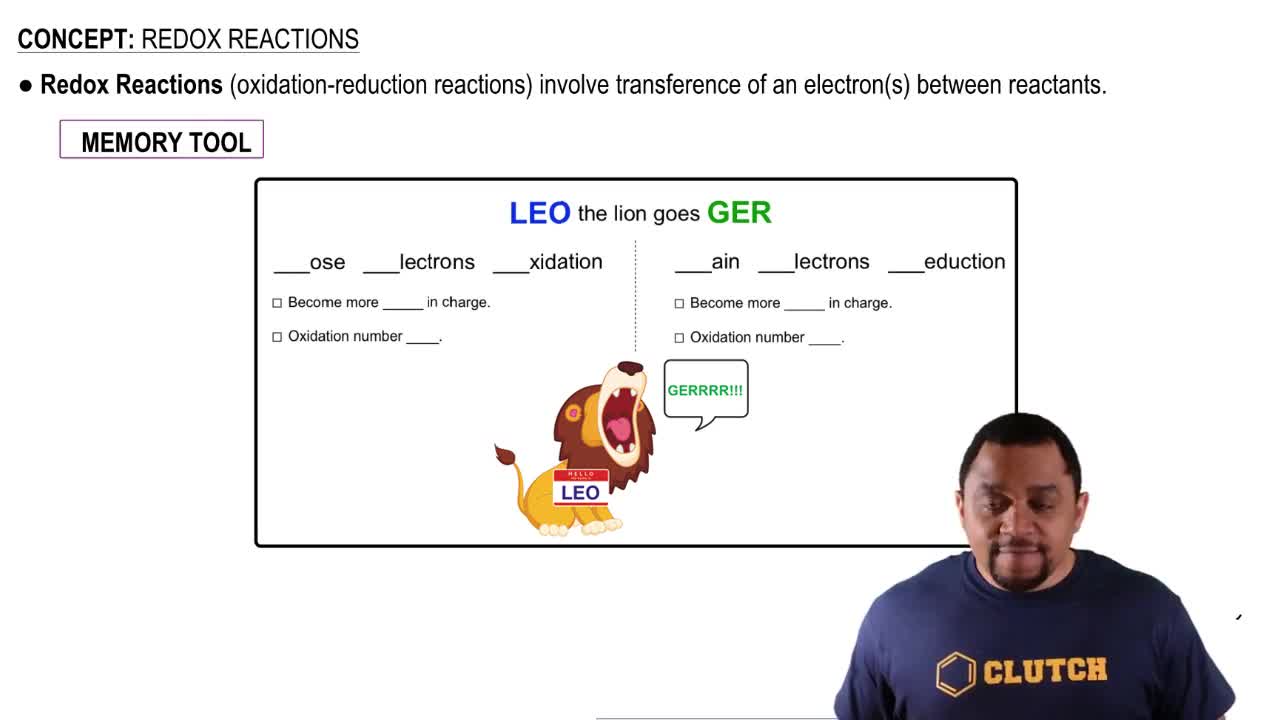
Oxidation is the process where a substance loses electrons, while reduction is the gain of electrons. In electrochemical cells, the anode is where oxidation occurs, and the cathode is where reduction takes place. Identifying which species is oxidized and which is reduced helps in determining the half-reactions and understanding the flow of electrons in the circuit.
Video consigliato:
Percorso guidato
01:53
Oxidation and Reduction Reactions

Electrochemical Cells

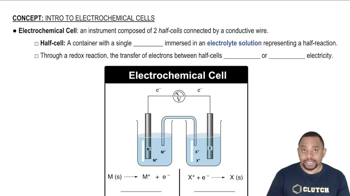
Electrochemical cells convert chemical energy into electrical energy through redox reactions. They consist of two electrodes (anode and cathode) and an electrolyte. The flow of electrons from the anode to the cathode generates electric current. Knowing the structure and function of electrochemical cells is essential for analyzing battery reactions and their applications.
Video consigliato:
Percorso guidato
02:46
Electrochemical Cells