

Ch.20 - Electrochemistry
Brown - Chemistry: The Central Science 14th Edition
Brown14th EditionChemistry: The Central ScienceISBN: 9780134414232Non è quello che usi tu?Cambia libro di testo
Capitolo 20, Problema 80a

Li-ion batteries used in automobiles typically use a LiMn2O4 cathode in place of the LiCoO2 cathode found in most Li-ion batteries. (a) Calculate the mass percent lithium in each electrode material.

Guida verificata passo dopo passo
1
Step 1: Determine the molar mass of each compound.
Step 2: Calculate the molar mass of lithium (Li).
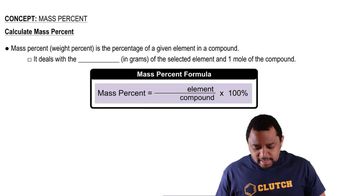
Step 3: Find the mass percent of lithium in LiMn2O4 by dividing the molar mass of Li by the molar mass of LiMn2O4 and multiplying by 100.
Step 4: Find the mass percent of lithium in LiCoO2 by dividing the molar mass of Li by the molar mass of LiCoO2 and multiplying by 100.
Step 5: Compare the mass percent of lithium in both compounds to understand the difference in lithium content.

Risposta video verificata per un problema simile:

Questa soluzione video è stata consigliata dai nostri tutor come utile per risolvere questo problema.
Durata del video:
3m

Concetti chiave

Ecco i concetti essenziali che devi comprendere per rispondere correttamente alla domanda.

Mass Percent Composition

Mass percent composition is a way to express the concentration of an element in a compound. It is calculated by taking the mass of the element in one mole of the compound, dividing it by the molar mass of the compound, and then multiplying by 100. This concept is essential for determining the proportion of lithium in the cathode materials LiMn2O4 and LiCoO2.
Video consigliato:
Percorso guidato
00:38
Mass Percent Calculation

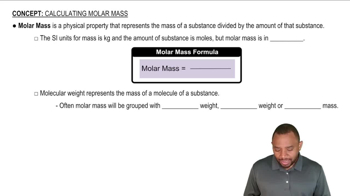
Molar Mass

Molar mass is the mass of one mole of a substance, typically expressed in grams per mole (g/mol). It is calculated by summing the atomic masses of all the atoms in a chemical formula. Understanding molar mass is crucial for converting between grams and moles, which is necessary for calculating mass percent composition in the given electrode materials.
Video consigliato:
Percorso guidato
02:11
Molar Mass Concept

Chemical Formula Interpretation

Interpreting chemical formulas involves understanding the types and quantities of atoms present in a compound. For example, in LiMn2O4, the formula indicates that there are two manganese (Mn) atoms and four oxygen (O) atoms for every lithium (Li) atom. This knowledge is vital for accurately calculating the mass percent of lithium in the cathode materials by identifying the contributions of each element to the total mass.
Video consigliato:
Percorso guidato
03:13
Intepreting the Band of Stability
Pratica correlata
Domanda del libro di testo

In some applications nickel–cadmium batteries have been replaced by nickel–zinc batteries. The overall cell reaction for this relatively new battery is: 2 H2O(l) + 2 NiO(OH)(s) + Zn(s) → 2 Ni(OH)2(s) + Zn(OH)2(s) (c) A single nickel–cadmium cell has a voltage of 1.30 V. Based on the difference in the standard reduction potentials of Cd2+ and Zn2+, what voltage would you estimate a nickel–zinc battery will produce? (d) Would you expect the specific energy density of a nickel–zinc battery to be higher or lower than that of a nickel–cadmium battery?

597
views
Domanda del libro di testo

In some applications nickel–cadmium batteries have been replaced by nickel–zinc batteries. The overall cell reaction for this relatively new battery is: 2 H2O(l) + 2 NiO(OH)(s) + Zn(s) → 2 Ni(OH)2(s) + Zn(OH)2(s) (b) What is the anode half-reaction?

622
views
Domanda del libro di testo

Li-ion batteries used in automobiles typically use a LiMn2O4 cathode in place of the LiCoO2 cathode found in most Li-ion batteries. (b) Which material has a higher percentage of lithium? Does this help to explain why batteries made with LiMn2O4 cathodes deliver less power on discharging?

346
views
Domanda del libro di testo

Li-ion batteries used in automobiles typically use a LiMn2O4 cathode in place of the LiCoO2 cathode found in most Li-ion batteries. (c) In a battery that uses a LiCoO2 cathode, approximately 50% of the lithium migrates from the cathode to the anode on charging. In a battery that uses a LiMn2O4 cathode, what fraction of the lithium in LiMn2O4 would need to migrate out of the cathode to deliver the same amount of lithium to the graphite anode?

415
views