
In the Brønsted–Lowry concept of acids and bases, acid– base reactions are viewed as proton-transfer reactions. The stronger the acid, the weaker is its conjugate base. If we were to think of redox reactions in a similar way, what particle would be analogous to the proton? Would strong oxidizing agents be analogous to strong acids or strong bases? [Sections 20.1 and 20.2]
Ch.20 - Electrochemistry
Brown14th EditionChemistry: The Central ScienceISBN: 9780134414232Non è quello che usi tu?Cambia libro di testo
Capitolo 20, Problema 2
Indicate whether the following balanced equations involve oxidation–reduction. If they do, identify the elements that undergo changes in oxidation number. (b) 2 PbO2(s) → 2 PbO(s) + O2(g) (c) 2 H2SO4(aq) + 2 NaBr(s) → Br2(l) + SO2(g) + Na2SO4(aq) + 2 H2O(l)
Guida verificata passo dopo passo1
Step 1: Understand the concept of oxidation-reduction (redox) reactions. These involve the transfer of electrons between species, leading to changes in oxidation numbers of elements involved.
Step 2: For equation (b) 2 PbO_2(s) → 2 PbO(s) + O_2(g), determine the oxidation states of lead (Pb) and oxygen (O) in both reactants and products. In PbO_2, Pb is typically +4 and O is -2. In PbO, Pb is +2 and O is -2.
Step 3: Analyze the changes in oxidation states for equation (b). Lead (Pb) changes from +4 in PbO_2 to +2 in PbO, indicating a reduction. Oxygen (O) changes from -2 in PbO_2 to 0 in O_2, indicating an oxidation.
Step 4: For equation (c) 2 H_2SO_4(aq) + 2 NaBr(s) → Br_2(l) + SO_2(g) + Na_2SO_4(aq) + 2 H_2O(l), determine the oxidation states of sulfur (S), bromine (Br), and other elements in both reactants and products. In H_2SO_4, S is +6, and in NaBr, Br is -1.
Step 5: Analyze the changes in oxidation states for equation (c). Bromine (Br) changes from -1 in NaBr to 0 in Br_2, indicating an oxidation. Sulfur (S) changes from +6 in H_2SO_4 to +4 in SO_2, indicating a reduction.
Concetti chiave
Ecco i concetti essenziali che devi comprendere per rispondere correttamente alla domanda.
Oxidation-Reduction Reactions
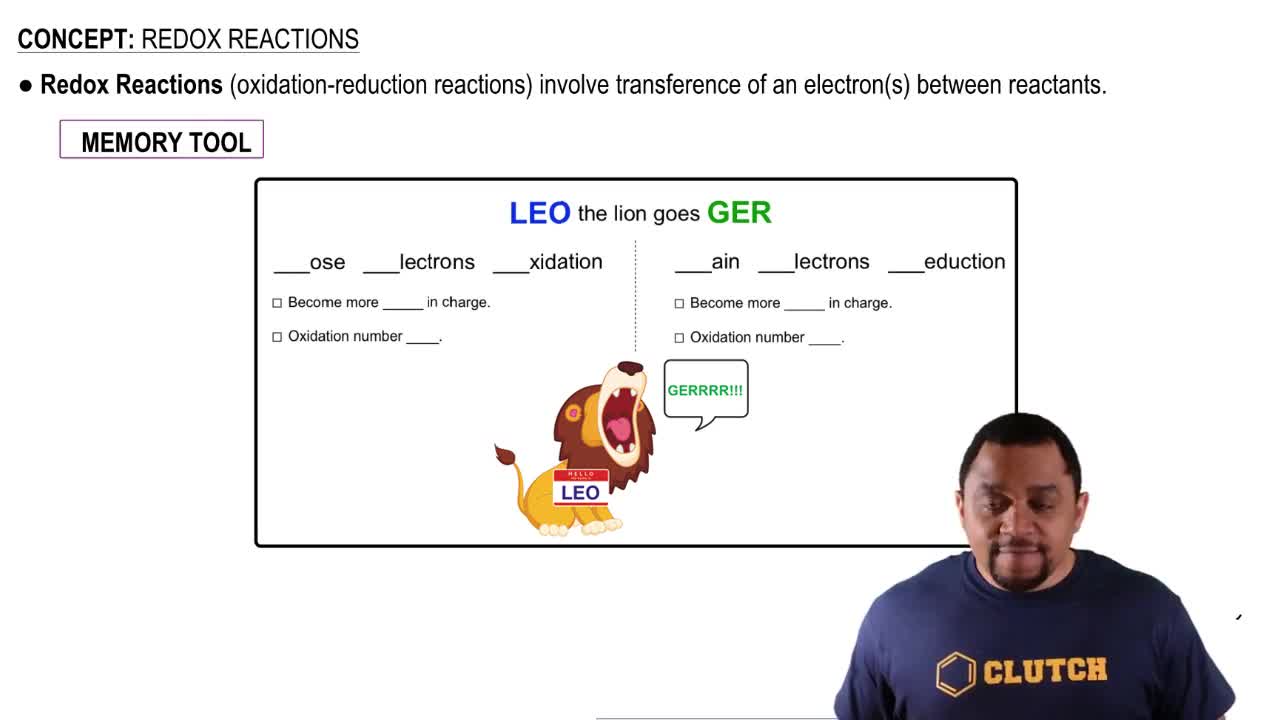
Oxidation-reduction (redox) reactions involve the transfer of electrons between substances, leading to changes in oxidation states. In these reactions, oxidation refers to the loss of electrons, while reduction refers to the gain of electrons. Identifying whether a reaction is a redox process requires analyzing the oxidation states of the elements involved before and after the reaction.
Video consigliato:
Percorso guidato
Oxidation and Reduction Reactions
Oxidation States
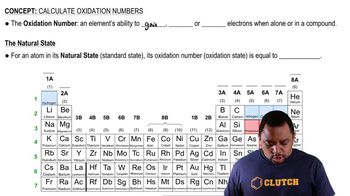
Oxidation states (or oxidation numbers) are assigned to atoms in a compound to indicate their degree of oxidation or reduction. These states help track the movement of electrons during chemical reactions. Common rules for determining oxidation states include that the oxidation state of an element in its elemental form is zero, and for compounds, the sum of oxidation states must equal the overall charge of the molecule.
Video consigliato:
Percorso guidato
Oxidation Numbers
Balancing Chemical Equations
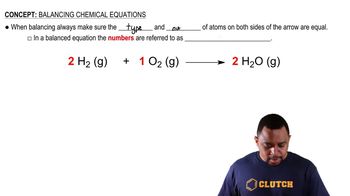
Balancing chemical equations ensures that the number of atoms for each element is the same on both sides of the equation, reflecting the law of conservation of mass. In redox reactions, balancing also involves ensuring that the total charge is the same on both sides. This process often requires adjusting coefficients and can involve half-reactions to separately account for oxidation and reduction processes.
Video consigliato:
Percorso guidato
Balancing Chemical Equations
Pratica correlata
Domanda del libro di testo
1069
views
Domanda del libro di testo
The diagram that follows represents a molecular view of a process occurring at an electrode in a voltaic cell.
(b) Is the electrode the anode or cathode?
359
views
Domanda del libro di testo
The diagram that follows represents a molecular view of a process occurring at an electrode in a voltaic cell.
(c) Why are the atoms in the electrode represented by larger spheres than those in the solution? [Section 20.3]
628
views
Domanda del libro di testo
The diagram that follows represents a molecular view of a process occurring at an electrode in a voltaic cell.
(a) Does the process represent oxidation or reduction?
636
views
