
In the Brønsted–Lowry concept of acids and bases, acid– base reactions are viewed as proton-transfer reactions. The stronger the acid, the weaker is its conjugate base. If we were to think of redox reactions in a similar way, what particle would be analogous to the proton? Would strong oxidizing agents be analogous to strong acids or strong bases? [Sections 20.1 and 20.2]
Ch.20 - Electrochemistry
Brown14th EditionChemistry: The Central ScienceISBN: 9780134414232Non è quello che usi tu?Cambia libro di testo
Capitolo 20, Problema 3a
The diagram that follows represents a molecular view of a process occurring at an electrode in a voltaic cell.

(a) Does the process represent oxidation or reduction?

Guida verificata passo dopo passo1
Identify the process occurring at the electrode by observing the movement of particles in the diagram.
Note that the particles are moving away from the electrode, indicating a loss of particles from the electrode surface.
Understand that in a voltaic cell, oxidation occurs at the anode where there is a loss of electrons, and reduction occurs at the cathode where there is a gain of electrons.
Recognize that the loss of particles from the electrode suggests that the electrode is losing electrons, which is characteristic of oxidation.
Conclude that the process represented in the diagram is oxidation, as the electrode is losing particles (electrons).

Risposta video verificata per un problema simile:
Questa soluzione video è stata consigliata dai nostri tutor come utile per risolvere questo problema.
Durata del video:
53sConcetti chiave
Ecco i concetti essenziali che devi comprendere per rispondere correttamente alla domanda.
Oxidation and Reduction
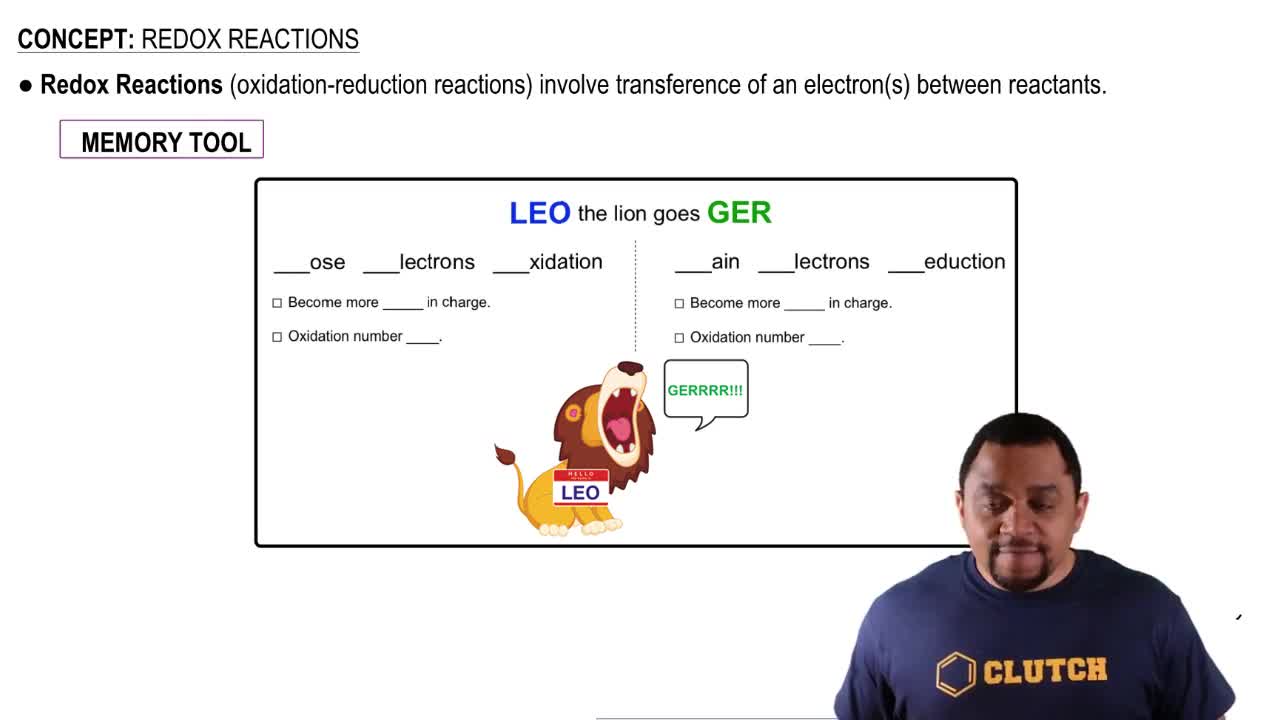
Oxidation and reduction are chemical processes that involve the transfer of electrons between species. Oxidation refers to the loss of electrons, while reduction involves the gain of electrons. In a voltaic cell, these processes occur at the electrodes, where oxidation typically happens at the anode and reduction at the cathode. Understanding which process is occurring is crucial for analyzing electrochemical reactions.
Video consigliato:
Percorso guidato
Oxidation and Reduction Reactions
Voltaic Cell
A voltaic cell, also known as a galvanic cell, is a device that converts chemical energy into electrical energy through spontaneous redox reactions. It consists of two electrodes (anode and cathode) immersed in an electrolyte solution. The flow of electrons from the anode to the cathode generates an electric current, making it essential to understand the roles of each electrode in the overall reaction.
Video consigliato:
Percorso guidato
The Electrolytic Cell
Electron Flow
In electrochemical cells, the flow of electrons is a fundamental concept that dictates the direction of current and the type of reaction occurring. Electrons flow from the anode, where oxidation occurs, to the cathode, where reduction takes place. This movement is crucial for the functioning of the voltaic cell and is visually represented in diagrams showing electron transfer during the redox process.
Video consigliato:
Percorso guidato
Electron Geometry
Pratica correlata
Domanda del libro di testo
1069
views
Domanda del libro di testo
The diagram that follows represents a molecular view of a process occurring at an electrode in a voltaic cell.
(b) Is the electrode the anode or cathode?
359
views
Domanda del libro di testo
The diagram that follows represents a molecular view of a process occurring at an electrode in a voltaic cell.
(c) Why are the atoms in the electrode represented by larger spheres than those in the solution? [Section 20.3]
628
views
Domanda del libro di testo
Assume that you want to construct a voltaic cell that uses the following half-reactions: A2+1aq2 + 2 e- ¡ A1s2 Ered ° = -0.10 V B2+1aq2 + 2 e- ¡ B1s2 E°red = -1.10 V You begin with the incomplete cell pictured here in which the electrodes are immersed in water.
(a) What additions must you make to the cell for it to generate a standard emf?
660
views
