Ch.20 - Electrochemistry
Brown - Chemistry: The Central Science 14th Edition
Brown14th EditionChemistry: The Central ScienceISBN: 9780134414232Non è quello che usi tu?Cambia libro di testo
Capitolo 20, Problema 37a

Using standard reduction potentials (Appendix E), calculate the standard emf for each of the following reactions: (a) Cl21g2 + 2 I-1aq2 ¡ 2 Cl-1aq2 + I21s2

Guida verificata passo dopo passo
1
Identify the half-reactions involved in the overall reaction. For the given reaction, the half-reactions are: \( \text{Cl}_2(g) + 2e^- \rightarrow 2\text{Cl}^-(aq) \) and \( 2\text{I}^-(aq) \rightarrow \text{I}_2(s) + 2e^- \).
Look up the standard reduction potentials for each half-reaction in Appendix E. The standard reduction potential for \( \text{Cl}_2(g) + 2e^- \rightarrow 2\text{Cl}^-(aq) \) is typically positive, while for \( \text{I}_2(s) + 2e^- \rightarrow 2\text{I}^-(aq) \) it is less positive.
Reverse the oxidation half-reaction to match the direction of the given reaction. This means reversing \( 2\text{I}^-(aq) \rightarrow \text{I}_2(s) + 2e^- \) to \( \text{I}_2(s) + 2e^- \rightarrow 2\text{I}^-(aq) \) and changing the sign of its standard reduction potential.
Calculate the standard electromotive force (emf) of the reaction by adding the standard reduction potential of the reduction half-reaction (\( \text{Cl}_2(g) + 2e^- \rightarrow 2\text{Cl}^-(aq) \)) to the reversed oxidation potential (\( \text{I}_2(s) + 2e^- \rightarrow 2\text{I}^-(aq) \)).
The standard emf of the reaction is the sum of the potentials from step 4. This value indicates the tendency of the reaction to occur spontaneously under standard conditions.

Risposta video verificata per un problema simile:

Questa soluzione video è stata consigliata dai nostri tutor come utile per risolvere questo problema.
Durata del video:
4m

Concetti chiave

Ecco i concetti essenziali che devi comprendere per rispondere correttamente alla domanda.

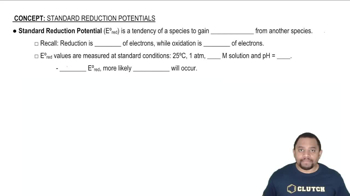
Standard Reduction Potentials

Standard reduction potentials are measured voltages that indicate the tendency of a chemical species to gain electrons and be reduced. Each half-reaction has a specific potential, typically measured under standard conditions (1 M concentration, 1 atm pressure, and 25°C). These values are crucial for predicting the direction of redox reactions and calculating the overall cell potential.
Video consigliato:
Percorso guidato
01:10
Standard Reduction Potentials

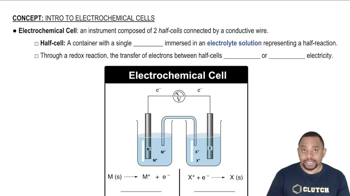
Electrochemical Cell and EMF

An electrochemical cell consists of two half-cells where oxidation and reduction reactions occur. The electromotive force (EMF) is the voltage generated by the cell when no current is flowing, representing the maximum potential difference between the two electrodes. The standard EMF can be calculated using the standard reduction potentials of the half-reactions involved.
Video consigliato:
Percorso guidato
02:46
Electrochemical Cells

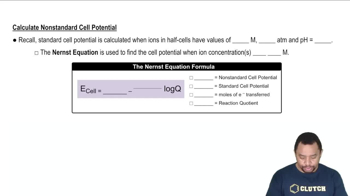
Nernst Equation

The Nernst equation relates the cell potential to the concentrations of the reactants and products in a redox reaction. It allows for the calculation of the EMF under non-standard conditions, taking into account temperature and concentration changes. Understanding this equation is essential for accurately determining the cell potential in various scenarios.
Video consigliato:
Percorso guidato
01:17
The Nernst Equation