
Ch.21 - Nuclear Chemistry
Brown - Chemistry: The Central Science 14th Edition
Brown14th EditionChemistry: The Central ScienceISBN: 9780134414232Non è quello che usi tu?Cambia libro di testo
Capitolo 21, Problema 74a

Chlorine has two stable nuclides, 35Cl and 37Cl. In contrast, 36Cl is a radioactive nuclide that decays by beta emission. (a) What is the product of decay of 36Cl?

Guida verificata passo dopo passo
1
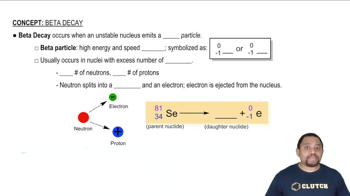
Identify the type of decay: 36Cl undergoes beta decay, which involves the conversion of a neutron into a proton, emitting a beta particle (an electron) and an antineutrino.
Write the nuclear equation for beta decay: In beta decay, the atomic number increases by 1 while the mass number remains unchanged.
Determine the new element: Since the atomic number increases by 1, the element changes from chlorine (Cl) to the next element in the periodic table, which is argon (Ar).
Write the balanced nuclear equation: \( ^{36}_{17}\text{Cl} \rightarrow ^{36}_{18}\text{Ar} + \beta^- + \bar{\nu}_e \), where \( \beta^- \) is the beta particle and \( \bar{\nu}_e \) is the antineutrino.
Conclude the product: The product of the beta decay of 36Cl is 36Ar.

Risposta video verificata per un problema simile:

Questa soluzione video è stata consigliata dai nostri tutor come utile per risolvere questo problema.
Durata del video:
2m

Concetti chiave

Ecco i concetti essenziali che devi comprendere per rispondere correttamente alla domanda.

Beta Decay

Beta decay is a type of radioactive decay in which a beta particle (an electron or a positron) is emitted from an atomic nucleus. In the case of beta minus decay, a neutron is transformed into a proton, resulting in the emission of an electron and an antineutrino. This process increases the atomic number of the element by one, leading to the formation of a new element.
Video consigliato:

Nuclear Stability

Nuclear stability refers to the ability of an atomic nucleus to remain intact without undergoing radioactive decay. Stable nuclides, like 35Cl and 37Cl, have a balanced ratio of protons to neutrons, while unstable nuclides, such as 36Cl, have an imbalance that leads to decay. Understanding the factors that contribute to nuclear stability is essential for predicting the behavior of different isotopes.
Video consigliato:
Percorso guidato
03:29
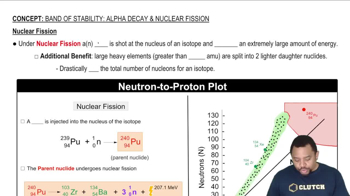
Band of Stability: Nuclear Fission

Decay Products

Decay products are the new elements or isotopes formed as a result of radioactive decay. In the case of 36Cl undergoing beta decay, the decay product is 37Ar (argon), as the emission of a beta particle transforms the chlorine nucleus into an argon nucleus. Identifying decay products is crucial for understanding the implications of radioactive decay in various applications, including nuclear medicine and radiometric dating.
Video consigliato: