
Ch.21 - Nuclear Chemistry
Brown - Chemistry: The Central Science 14th Edition
Brown14th EditionChemistry: The Central ScienceISBN: 9780134414232Non è quello che usi tu?Cambia libro di testo
Capitolo 21, Problema 72

Radon-222 decays to a stable nucleus by a series of three alpha emissions and two beta emissions. What is the stable nucleus that is formed?

Guida verificata passo dopo passo
1
Identify the initial nucleus: Radon-222 (\(^{222}_{86}\text{Rn}\)).
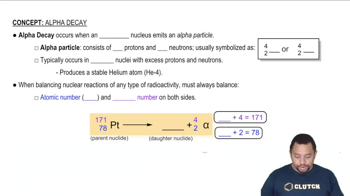
Understand that an alpha particle emission reduces the atomic number by 2 and the mass number by 4. Therefore, three alpha emissions will reduce the atomic number by 6 and the mass number by 12.
Calculate the new atomic number and mass number after three alpha emissions: \(^{222}_{86}\text{Rn} \rightarrow ^{210}_{80}\text{X}\).
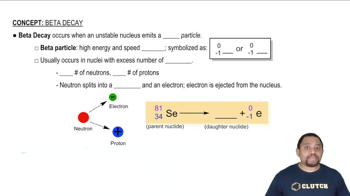
Recognize that a beta particle emission increases the atomic number by 1 without changing the mass number. Therefore, two beta emissions will increase the atomic number by 2.
Calculate the final atomic number and mass number after two beta emissions: \(^{210}_{80}\text{X} \rightarrow ^{210}_{82}\text{Pb}\). The stable nucleus formed is Lead-210 (\(^{210}_{82}\text{Pb}\)).

Risposta video verificata per un problema simile:

Questa soluzione video è stata consigliata dai nostri tutor come utile per risolvere questo problema.
Durata del video:
5m

Concetti chiave

Ecco i concetti essenziali che devi comprendere per rispondere correttamente alla domanda.

Alpha Decay

Alpha decay is a type of radioactive decay in which an unstable nucleus emits an alpha particle, consisting of two protons and two neutrons. This process decreases the atomic number by two and the mass number by four, leading to the formation of a new element. Understanding alpha decay is crucial for tracking the changes in the nucleus during the decay process.
Video consigliato:

Beta Decay

Beta decay occurs when a neutron in an unstable nucleus is transformed into a proton, emitting a beta particle (an electron or positron) in the process. This increases the atomic number by one while keeping the mass number unchanged. Recognizing how beta decay alters the composition of the nucleus is essential for determining the final stable nucleus after multiple decay events.
Video consigliato:

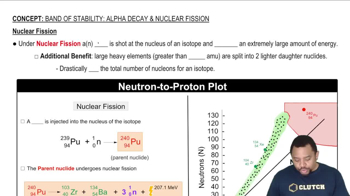
Nuclear Stability

Nuclear stability refers to the ability of a nucleus to remain intact without undergoing radioactive decay. Stable nuclei have balanced ratios of protons to neutrons, which minimizes repulsive forces between protons. Identifying the stable nucleus formed after a series of decays requires understanding the stability criteria and the resulting changes in atomic and mass numbers from the decay processes.
Video consigliato:
Percorso guidato
03:29
Band of Stability: Nuclear Fission