Ch.21 - Nuclear Chemistry
Brown - Chemistry: The Central Science 14th Edition
Brown14th EditionChemistry: The Central ScienceISBN: 9780134414232Non è quello che usi tu?Cambia libro di testo
Capitolo 21, Problema 81a

Each of the following transmutations produces a radionuclide used in positron emission tomography (PET).
(a) In equations (i) and (ii), identify the species signified as 'X.'
(i) 14N(p,α)X
(ii) 18O(p,X)18F
(iii) 14N(d,n)15O

Guida verificata passo dopo passo
1
Identify the type of nuclear reaction occurring in each equation. For example, (i) and (ii) involve proton bombardment, while (iii) involves deuteron bombardment.
For equation (i) \( ^{14}\text{N} + ^1\text{p} \rightarrow \alpha + ^2\text{X} \), recognize that an alpha particle (\( \alpha \)) is a helium nucleus \( ^4\text{He} \). Use the conservation of mass and atomic numbers to find \( X \).
For equation (ii) \( ^{18}\text{O} + ^1\text{p} \rightarrow X + ^2\text{18}\text{F} \), apply the conservation of mass and atomic numbers to determine \( X \). Remember that \( ^{18}\text{F} \) is a fluorine isotope.
For equation (iii) \( ^{14}\text{N} + ^1\text{d} \rightarrow \text{n} + ^2\text{15}\text{O} \), note that \( ^1\text{d} \) is a deuteron (\( ^2\text{H} \)) and \( \text{n} \) is a neutron. Use conservation laws to find the missing species.
Verify your results by ensuring that both the mass numbers and atomic numbers are balanced on both sides of each equation.

Risposta video verificata per un problema simile:

Questa soluzione video è stata consigliata dai nostri tutor come utile per risolvere questo problema.
Durata del video:
9m

Concetti chiave

Ecco i concetti essenziali che devi comprendere per rispondere correttamente alla domanda.

Nuclear Transmutation

Nuclear transmutation is the process by which one element or isotope is converted into another through nuclear reactions. This can occur naturally or artificially, often involving the bombardment of nuclei with particles such as protons or neutrons. Understanding this concept is crucial for identifying the species 'X' in the given equations, as it relates to how elements change during these reactions.
Video consigliato:
Percorso guidato
02:06
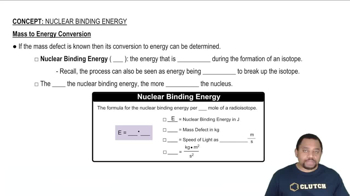
Nuclear Binding Energy

Radionuclides and Positron Emission Tomography (PET)

Radionuclides are unstable isotopes that decay and emit radiation, which can be harnessed in medical imaging techniques like positron emission tomography (PET). In PET, radionuclides are used to visualize metabolic processes in the body. Recognizing the role of radionuclides in PET is essential for understanding the significance of the transmutations described in the question.
Video consigliato:
Percorso guidato
01:53
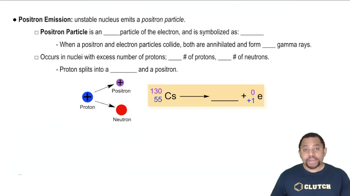
Positron Emission

Nuclear Notation

Nuclear notation is a shorthand representation of an atomic nucleus, indicating the element's symbol, atomic number, and mass number. For example, in the notation 14N1, '14' represents the mass number (total protons and neutrons), while '1' indicates the atomic number (number of protons). Familiarity with nuclear notation is necessary to interpret the equations and identify the unknown species 'X' accurately.
Video consigliato:
Percorso guidato
02:50
Standard Notation to Scientific Notation