
Ch.21 - Nuclear Chemistry
Brown - Chemistry: The Central Science 14th Edition
Brown14th EditionChemistry: The Central ScienceISBN: 9780134414232Non è quello che usi tu?Cambia libro di testo
Capitolo 21, Problema 4c

In the sketch below, the red spheres represent protons and the gray spheres represent neutrons. (c) Based on its atomic number and mass number, do you think the product nucleus is stable or radioactive? [Section 21.3]
Illustration showing protons as red spheres and neutrons as gray spheres in nuclear stability.

Guida verificata passo dopo passo
1
Identify the number of protons (red spheres) and neutrons (gray spheres) in the product nucleus.
Determine the atomic number (Z) by counting the number of protons in the product nucleus.
Determine the mass number (A) by adding the number of protons and neutrons in the product nucleus.
Compare the neutron-to-proton ratio (N/Z) of the product nucleus to the known stable ratios for nuclei with similar atomic numbers.
Assess the stability of the product nucleus based on its neutron-to-proton ratio and known stability trends for nuclei in the same region of the periodic table.

Risposta video verificata per un problema simile:

Questa soluzione video è stata consigliata dai nostri tutor come utile per risolvere questo problema.
Durata del video:
2m

Concetti chiave

Ecco i concetti essenziali che devi comprendere per rispondere correttamente alla domanda.

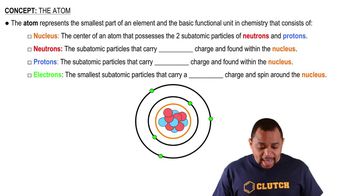
Atomic Number

The atomic number of an element is the number of protons in its nucleus, which determines the element's identity and its position on the periodic table. It also influences the chemical properties of the element and its reactivity. In the context of nuclear stability, the atomic number helps to assess the balance between protons and neutrons, which is crucial for determining whether a nucleus is stable or prone to radioactive decay.
Video consigliato:

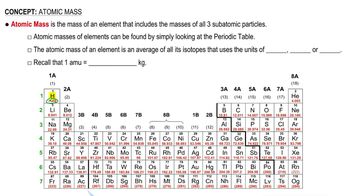
Mass Number

The mass number is the total number of protons and neutrons in an atomic nucleus. It provides insight into the overall size and stability of the nucleus. A higher mass number can indicate a greater likelihood of instability, especially if the ratio of neutrons to protons is not optimal. Understanding mass number is essential for evaluating whether a nucleus will remain stable or undergo radioactive decay.
Video consigliato:

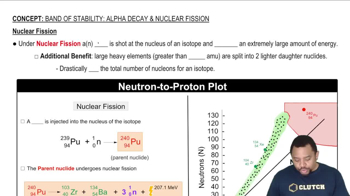
Nuclear Stability

Nuclear stability refers to the ability of a nucleus to remain intact without undergoing radioactive decay. This stability is influenced by the ratio of neutrons to protons; generally, a ratio close to 1:1 is stable for lighter elements, while heavier elements require more neutrons to offset the repulsive forces between protons. Analyzing the atomic and mass numbers helps predict whether a nucleus is stable or likely to be radioactive.
Video consigliato:
Percorso guidato
03:29
Band of Stability: Nuclear Fission