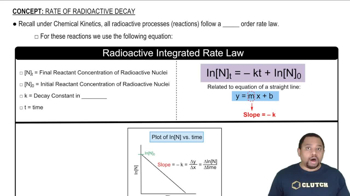
The accompanying graph illustrates the decay of 8842Mo, which decays via positron emission. (a) What is the halflife of the decay? [Section 21.4]
Ch.21 - Nuclear Chemistry
Brown14th EditionChemistry: The Central ScienceISBN: 9780134414232Non è quello che usi tu?Cambia libro di testo
Capitolo 21, Problema 5d
The steps below show three of the steps in the radioactive decay chain for 23290Th. The half-life of each isotope is shown below the symbol of the isotope. (d) The next step in the decay chain is an alpha emission. What is the next isotope in the chain? [Sections 21.2 and 21.4]
Guida verificata passo dopo passo1
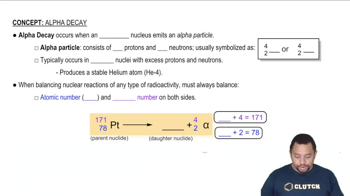
Identify the type of decay mentioned in the problem, which is alpha emission. Alpha emission involves the release of an alpha particle from the nucleus, which consists of 2 protons and 2 neutrons.
Determine the change in atomic number and mass number due to the alpha emission. The atomic number decreases by 2 and the mass number decreases by 4 because an alpha particle (which is a helium nucleus,
42He) is emitted.
Write the general equation for alpha decay:
AZX
->
A-4Z-2Y +
42He, where X is the parent isotope and Y is the daughter isotope.
Apply the alpha decay equation to the given isotope,
23290Th. Substitute A = 232 and Z = 90 into the equation to find the new isotope:
232-490-2Y =
22888Y.
Identify the element with atomic number 88, which is Radium (Ra). Therefore, the next isotope in the decay chain after alpha emission from
23290Th is
22888Ra.

Risposta video verificata per un problema simile:
Questa soluzione video è stata consigliata dai nostri tutor come utile per risolvere questo problema.
Durata del video:
3mConcetti chiave
Ecco i concetti essenziali che devi comprendere per rispondere correttamente alla domanda.
Radioactive Decay
Radioactive decay is the process by which an unstable atomic nucleus loses energy by emitting radiation. This can occur in various forms, including alpha, beta, and gamma decay. Each type of decay results in the transformation of the original isotope into a different element or isotope, characterized by a specific half-life, which is the time required for half of the radioactive atoms in a sample to decay.
Video consigliato:
Percorso guidato
Rate of Radioactive Decay
Alpha Emission
Alpha emission is a type of radioactive decay in which an atomic nucleus releases an alpha particle, consisting of two protons and two neutrons. This process decreases the atomic number of the original isotope by two and the mass number by four, resulting in the formation of a new element. Understanding alpha emission is crucial for predicting the next isotope in a decay chain.
Video consigliato:
Percorso guidato
Alpha Decay
Decay Chain
A decay chain, or radioactive series, is a sequence of decays that a radioactive isotope undergoes until it reaches a stable isotope. Each step in the chain involves the transformation of one isotope into another, often through various types of decay. The identification of the next isotope in a decay chain requires knowledge of the initial isotope and the type of decay occurring at each step.
Video consigliato:
Percorso guidato
Beta Decay
Pratica correlata
Domanda del libro di testo
580
views
Domanda del libro di testo
In the sketch below, the red spheres represent protons and the gray spheres represent neutrons. (c) Based on its atomic number and mass number, do you think the product nucleus is stable or radioactive? [Section 21.3]
500
views
1
rank
Domanda del libro di testo
The steps below show three of the steps in the radioactive decay chain for 23290Th. The half-life of each isotope is shown below the symbol of the isotope. (a) Identify the type of radioactive decay for each of the steps (i), (ii), and (iii). [Sections 21.2 and 21.4]
748
views
Domanda del libro di testo
The accompanying graph illustrates the decay of 8842Mo, which decays via positron emission. (b) What is the rate constant for the decay? [Section 21.4]
350
views