Ch.21 - Nuclear Chemistry
Brown - Chemistry: The Central Science 14th Edition
Brown14th EditionChemistry: The Central ScienceISBN: 9780134414232Non è quello che usi tu?Cambia libro di testo
Capitolo 21, Problema 6c

The accompanying graph illustrates the decay of 8842Mo, which decays via positron emission. (c) What fraction of the original sample of 8842Mo remains after 12 min? [Section 21.4]
Graph showing the decay of 8842Mo over time, illustrating mass decrease in grams.

Guida verificata passo dopo passo
1
Identify the half-life of 8842Mo from the graph. The half-life is the time it takes for the mass of the substance to reduce to half of its initial value.
Determine the initial mass of 8842Mo from the graph at time t = 0.
Find the mass of 8842Mo at the time corresponding to one half-life, two half-lives, etc., until you reach 12 minutes.
Calculate the number of half-lives that have passed in 12 minutes by dividing 12 minutes by the half-life duration.
Use the formula for exponential decay, N(t) = N_0 * (1/2)^(t/T), where N(t) is the remaining quantity, N_0 is the initial quantity, t is the elapsed time, and T is the half-life, to find the fraction of the original sample remaining after 12 minutes.

Risposta video verificata per un problema simile:

Questa soluzione video è stata consigliata dai nostri tutor come utile per risolvere questo problema.
Durata del video:
1m

Concetti chiave

Ecco i concetti essenziali che devi comprendere per rispondere correttamente alla domanda.

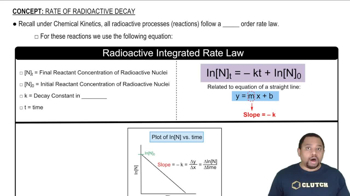
Radioactive Decay

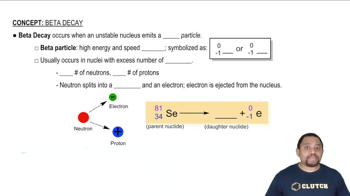
Radioactive decay is the process by which an unstable atomic nucleus loses energy by emitting radiation. This can occur in various forms, including alpha, beta, and positron emissions. The decay of isotopes, such as 88Mo, follows a predictable pattern characterized by a half-life, which is the time required for half of the radioactive sample to decay.
Video consigliato:
Percorso guidato
03:00
Rate of Radioactive Decay

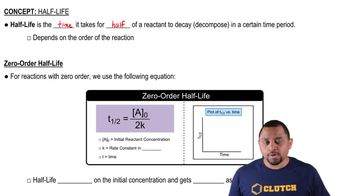
Half-Life

The half-life of a radioactive isotope is the time it takes for half of the original amount of the substance to decay. This concept is crucial for calculating the remaining quantity of a radioactive material after a certain period. For example, if the half-life of 88Mo is known, one can determine how much of the original sample remains after a specified time, such as 12 minutes.
Video consigliato:
Percorso guidato
02:17
Zero-Order Half-life

Exponential Decay

Exponential decay describes the process where the quantity of a substance decreases at a rate proportional to its current value. In the context of radioactive decay, this means that the mass of the radioactive isotope decreases rapidly at first and then slows down over time. The graph provided illustrates this behavior, showing a steep decline initially that flattens as time progresses.
Video consigliato: