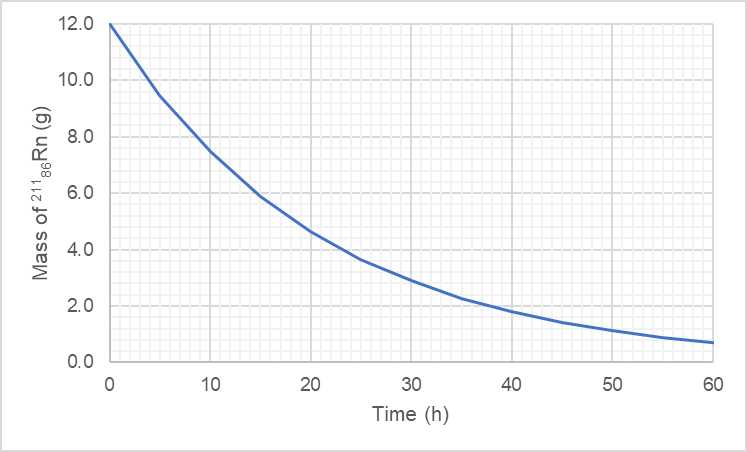
The accompanying graph illustrates the decay of 8842Mo, which decays via positron emission. (a) What is the halflife of the decay? [Section 21.4]
Ch.21 - Nuclear Chemistry
Brown14th EditionChemistry: The Central ScienceISBN: 9780134414232Non è quello che usi tu?Cambia libro di testo
Capitolo 21, Problema 6d
The accompanying graph illustrates the decay of 8842Mo, which decays via positron emission. (d) What is the product of the decay process? [Section 21.4]

Guida verificata passo dopo passo1
Identify the initial isotope undergoing decay: ^{88}_{42}Mo.
Determine the type of decay: positron emission (β^+ decay).
Write the nuclear equation for positron emission: ^{88}_{42}Mo → ^{88}_{41}Nb + β^+.
Identify the product of the decay process: the new element formed is Niobium (Nb) with a mass number of 88 and an atomic number of 41.
Verify the conservation of mass and atomic numbers in the nuclear equation to ensure the correctness of the product.

Risposta video verificata per un problema simile:
Questa soluzione video è stata consigliata dai nostri tutor come utile per risolvere questo problema.
Durata del video:
2mConcetti chiave
Ecco i concetti essenziali che devi comprendere per rispondere correttamente alla domanda.
Radioactive Decay
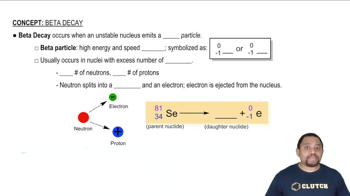
Radioactive decay is the process by which an unstable atomic nucleus loses energy by emitting radiation. This can occur through various modes, including alpha decay, beta decay, and positron emission. In the case of positron emission, a proton in the nucleus is transformed into a neutron, releasing a positron and a neutrino, which results in a decrease in the atomic number of the element.
Video consigliato:
Percorso guidato
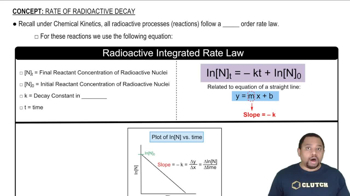
Rate of Radioactive Decay
Decay Products
The decay product is the new element or isotope formed as a result of radioactive decay. For example, when molybdenum-88 (
88
42Mo) undergoes positron emission, it transforms into a different element with a lower atomic number. Understanding the decay products is crucial for applications in nuclear chemistry, medicine, and radiometric dating.
Video consigliato:
Percorso guidato
Beta Decay
Half-Life
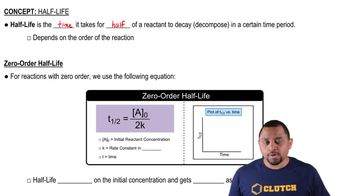
Half-life is the time required for half of the radioactive nuclei in a sample to decay. This concept is essential for predicting the behavior of radioactive substances over time. The graph provided illustrates the decay of radon-218, showing how the mass decreases exponentially, which is characteristic of half-life behavior in radioactive decay processes.
Video consigliato:
Percorso guidato
Zero-Order Half-life
Pratica correlata
Domanda del libro di testo
580
views
Domanda del libro di testo
All the stable isotopes of boron, carbon, nitrogen, oxygen, and fluorine are shown in the accompanying chart (in red), along with their radioactive isotopes with t1>2 7 1 min (in blue). (b) Which radioactive isotopes are most likely to decay by beta emission? [Sections 21.2, 21.4, and 21.5]
844
views
Domanda del libro di testo
The accompanying graph illustrates the decay of 8842Mo, which decays via positron emission. (c) What fraction of the original sample of 8842Mo remains after 12 min? [Section 21.4]
496
views
Domanda del libro di testo
The accompanying graph illustrates the decay of 8842Mo, which decays via positron emission. (b) What is the rate constant for the decay? [Section 21.4]
350
views