Ch.22 - Chemistry of the Nonmetals

Brown14th EditionChemistry: The Central ScienceISBN: 9780134414232
Non è quello che usi tu?Cambia libro di testoScegli un libro di testo diverso
TOC.tableOfContents
- Ch.1 - Introduction: Matter, Energy, and Measurement177
- Ch.2 - Atoms, Molecules, and Ions231
- Ch.3 - Chemical Reactions and Reaction Stoichiometry216
- Ch.4 - Reactions in Aqueous Solution189
- Ch.5 - Thermochemistry175
- Ch.6 - Electronic Structure of Atoms168
- Ch.7 - Periodic Properties of the Elements150
- Ch.8 - Basic Concepts of Chemical Bonding177
- Ch.9 - Molecular Geometry and Bonding Theories200
- Ch.10 - Gases179
- Ch.11 - Liquids and Intermolecular Forces113
- Ch.12 - Solids and Modern Materials154
- Ch.13 - Properties of Solutions157
- Ch.14 - Chemical Kinetics199
- Ch.15 - Chemical Equilibrium128
- Ch.16 - Acid-Base Equilibria164
- Ch.17 - Additional Aspects of Aqueous Equilibria163
- Ch.18 - Chemistry of the Environment105
- Ch.19 - Chemical Thermodynamics164
- Ch.20 - Electrochemistry171
- Ch.21 - Nuclear Chemistry122
- Ch.22 - Chemistry of the Nonmetals82
- Ch.23 - Transition Metals and Coordination Chemistry79
- Ch.24 - The Chemistry of Life: Organic and Biological Chemistry16
Brown14th EditionChemistry: The Central ScienceISBN: 9780134414232Non è quello che usi tu?Cambia libro di testo

Capitolo 22, Problema 17
Complete the exercises below. Complete and balance the following equations: a. NaOCH₃ (s) + H₂O (l) →
 Guida verificata passo dopo passo
1
Identify the reactants and products in the chemical equation. Here, sodium methoxide (NaOCH₃) reacts with water (H₂O).
Predict the products of the reaction. Sodium methoxide is a strong base and will react with water to form methanol (CH₃OH) and sodium hydroxide (NaOH).
Write the unbalanced chemical equation: NaOCH₃ (s) + H₂O (l) → CH₃OH (aq) + NaOH (aq).
Count the number of each type of atom on both sides of the equation to ensure they are equal. In this case, there is 1 Na, 1 O, 1 C, and 4 H atoms on both sides.
Since the number of each type of atom is already balanced, the equation is complete: NaOCH₃ (s) + H₂O (l) → CH₃OH (aq) + NaOH (aq).
Concetti chiave
Ecco i concetti essenziali che devi comprendere per rispondere correttamente alla domanda.
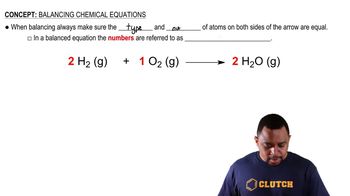
Balancing Chemical Equations
Balancing chemical equations is essential to ensure that the law of conservation of mass is upheld, meaning the number of atoms of each element must be the same on both sides of the equation. This involves adjusting coefficients in front of compounds to achieve equal numbers of each type of atom, reflecting the actual stoichiometry of the reaction.
Video consigliato:
Percorso guidato
 01:32
01:32
Balancing Chemical Equations
Reactants and Products
In a chemical reaction, reactants are the starting substances that undergo a transformation, while products are the substances formed as a result of the reaction. Understanding the identities and states of reactants and products is crucial for predicting the outcome of the reaction and for balancing the equation correctly.
Video consigliato:
Percorso guidato
 00:53
00:53Production of Hydrogen Example
Solubility and Reaction Types
The solubility of compounds in water affects whether a reaction occurs and how it proceeds. For example, sodium methoxide (NaOCH₃) is a strong base that can react with water, leading to the formation of methanol and hydroxide ions. Recognizing the types of reactions, such as acid-base reactions, helps in predicting the products and balancing the equation.
Video consigliato:
Percorso guidato
 02:25
02:25Common Types of Alkane Reactions
Pratica correlata