

Ch.23 - Transition Metals and Coordination Chemistry
Brown - Chemistry: The Central Science 14th Edition
Brown14th EditionChemistry: The Central ScienceISBN: 9780134414232Non è quello che usi tu?Cambia libro di testo
Capitolo 23, Problema 52b

The lobes of which d orbitals point directly between the ligands in b. tetrahedral geometry?

Guida verificata passo dopo passo
1
Identify the geometry of the molecule in question, which is tetrahedral in this case.
Recall that in tetrahedral geometry, the ligands are positioned at the corners of a tetrahedron with bond angles of approximately 109.5 degrees.
Understand that d orbitals in an atom are shaped differently and include the d_xy, d_xz, d_yz, d_x^2-y^2, and d_z^2 orbitals.
Analyze which d orbitals would have lobes pointing directly between the ligands in a tetrahedral arrangement. This requires visualizing the orientation of the lobes relative to the positions of the ligands.
Conclude that the d orbitals with lobes pointing directly between the ligands in tetrahedral geometry are d_xy, d_xz, and d_yz, as their lobes point towards the edges of the tetrahedron rather than directly at the corners where the ligands are located.

Risposta video verificata per un problema simile:

Questa soluzione video è stata consigliata dai nostri tutor come utile per risolvere questo problema.
Durata del video:
2m

Concetti chiave

Ecco i concetti essenziali che devi comprendere per rispondere correttamente alla domanda.

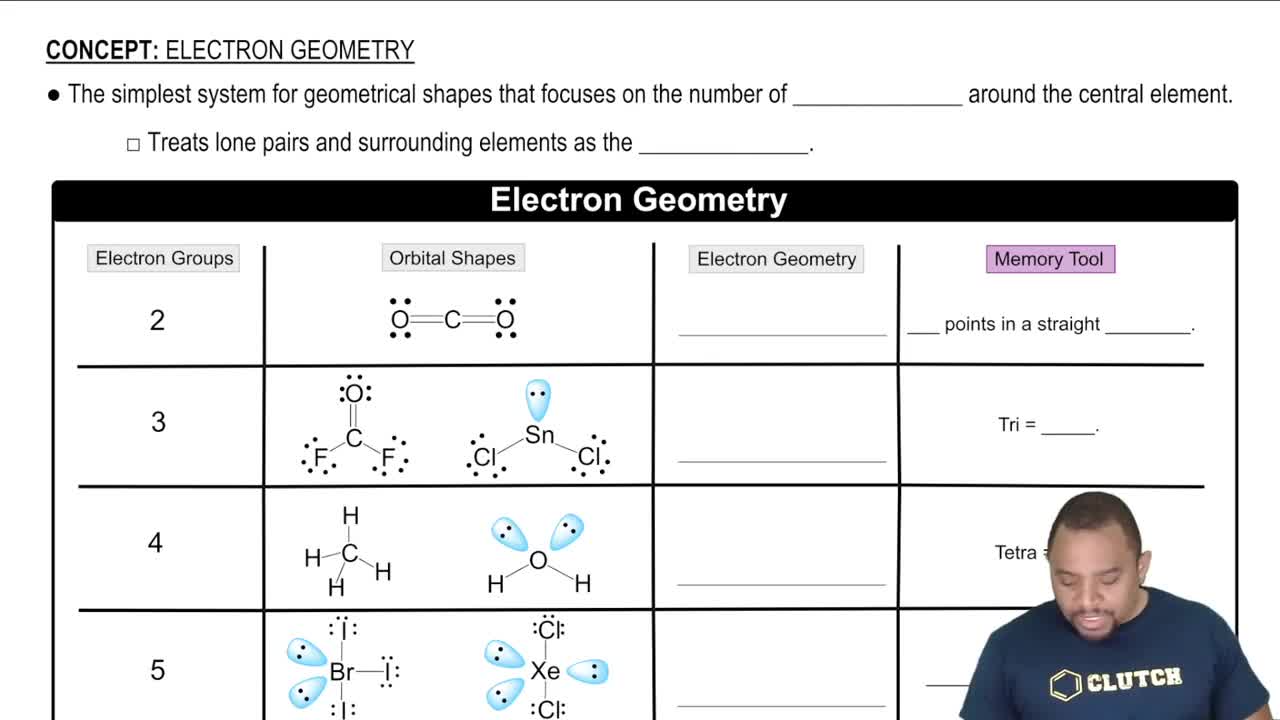
Tetrahedral Geometry

Tetrahedral geometry is a molecular shape that arises when a central atom is surrounded by four other atoms or groups of atoms, positioned at the corners of a tetrahedron. In this arrangement, the bond angles are approximately 109.5 degrees, minimizing electron pair repulsion according to VSEPR theory. This geometry is commonly observed in molecules like methane (CH4) and is crucial for understanding the spatial arrangement of ligands around a central atom.
Video consigliato:
Percorso guidato
04:44
Electron Geometry

d Orbitals

d orbitals are a set of five atomic orbitals that can hold a maximum of ten electrons. They are important in transition metals and play a significant role in bonding and the formation of complex ions. In tetrahedral coordination, the relevant d orbitals (specifically dxy, dyz, and dxz) are oriented such that their lobes point between the ligands, facilitating effective overlap and bonding interactions.
Video consigliato:
Percorso guidato
02:06
d Orbital Orientations

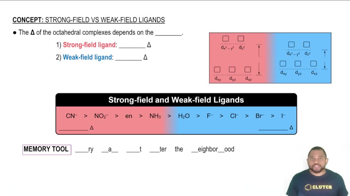
Ligand Field Theory

Ligand Field Theory (LFT) is an extension of crystal field theory that describes the electronic structure of transition metal complexes. It considers the effects of ligands on the energy levels of d orbitals, leading to splitting patterns that influence the geometry and reactivity of the complex. In tetrahedral complexes, the d orbitals split into two sets, with the lower-energy orbitals being those that point between the ligands, which is essential for understanding the bonding in such geometries.
Video consigliato:
Percorso guidato
02:40
Strong-Field Ligands result in a large Δ and Weak-Field Ligands result in a small Δ.