Ch.23 - Transition Metals and Coordination Chemistry
Brown - Chemistry: The Central Science 14th Edition
Brown14th EditionChemistry: The Central ScienceISBN: 9780134414232Non è quello che usi tu?Cambia libro di testo
Capitolo 23, Problema 54

As shown in Figure 23.26, the d-d transition of [Ti(H2O)6]³⁺ produces an absorption maximum at a wavelength of about 500 nm .


a. What is the magnitude of ∆ for [Ti(H2O)6]³⁺ in kJ/mol?


b. How would the magnitude of ∆ change if the H2O ligands in [Ti(H2O)6]]³⁺ were placed with NH3 ligands?

Guida verificata passo dopo passo
1
Step 1: Understand that the d-d transition refers to the energy difference (∆) between the split d-orbitals in a transition metal complex. This energy difference corresponds to the wavelength of light absorbed.
Step 2: Use the formula for energy of a photon: E = \( \frac{hc}{\lambda} \), where h is Planck's constant (6.626 x 10^-34 J·s), c is the speed of light (3.00 x 10^8 m/s), and \( \lambda \) is the wavelength in meters.
Step 3: Convert the given wavelength from nanometers to meters (500 nm = 500 x 10^-9 m) and substitute the values into the energy formula to find the energy in joules.
Step 4: Convert the energy from joules to kJ/mol by using Avogadro's number (6.022 x 10^23 mol^-1) to account for the number of molecules in a mole.
Step 5: For part b, consider the spectrochemical series, which ranks ligands by their ability to split d-orbitals. NH3 is a stronger field ligand than H2O, so replacing H2O with NH3 would increase the magnitude of ∆.

Risposta video verificata per un problema simile:

Questa soluzione video è stata consigliata dai nostri tutor come utile per risolvere questo problema.
Durata del video:
7m

Concetti chiave

Ecco i concetti essenziali che devi comprendere per rispondere correttamente alla domanda.

Crystal Field Theory

Crystal Field Theory (CFT) explains how the arrangement of ligands around a central metal ion affects its electronic structure and energy levels. In transition metal complexes, the d-orbitals split into different energy levels due to the electrostatic interactions between the metal ion and the surrounding ligands. This splitting is crucial for understanding the absorption of light, as electrons can be promoted between these split d-orbitals, leading to color and spectral properties.
Video consigliato:
Percorso guidato
01:18
The study of ligand-metal interactions helped to form Ligand Field Theory which combines CFT with MO Theory.

Ligand Field Strength

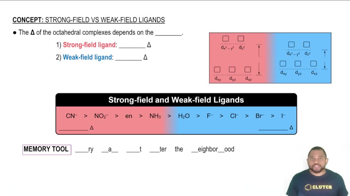
Ligand field strength refers to the ability of a ligand to influence the energy of the d-orbitals in a metal complex. Strong field ligands, like NH₃, cause a larger splitting of the d-orbitals compared to weak field ligands, such as H₂O. This difference in splitting affects the magnitude of the crystal field splitting energy (∆), which can be calculated from the wavelength of light absorbed during electronic transitions.
Video consigliato:
Percorso guidato
02:40
Strong-Field Ligands result in a large Δ and Weak-Field Ligands result in a small Δ.

Absorption Spectroscopy

Absorption spectroscopy is a technique used to measure the amount of light absorbed by a substance at different wavelengths. In the context of transition metal complexes, the wavelength at which maximum absorption occurs corresponds to the energy difference between the split d-orbitals. By applying the equation E = hc/λ, where E is energy, h is Planck's constant, c is the speed of light, and λ is the wavelength, one can determine the value of ∆ in kJ/mol.
Video consigliato:
Percorso guidato
03:29
Electronic Transitions