Ch.3 - Chemical Reactions and Reaction Stoichiometry
Brown - Chemistry: The Central Science 14th Edition
Brown14th EditionChemistry: The Central ScienceISBN: 9780134414232Non è quello che usi tu?Cambia libro di testo
Capitolo 3, Problema 74b

(b) Why is the actual yield in a reaction almost always less than the theoretical yield?

Guida verificata passo dopo passo
1
Understand that the theoretical yield is the maximum amount of product that can be formed from a given amount of reactants, assuming perfect conditions and complete conversion of reactants to products.
Recognize that the actual yield is the amount of product actually obtained from a reaction, which is often less than the theoretical yield due to various factors.
Consider that side reactions may occur, consuming some of the reactants and producing different products, thus reducing the amount of desired product.
Acknowledge that incomplete reactions can occur where not all reactants are converted into products, often due to equilibrium being established or reaction kinetics.
Realize that practical losses during the process, such as during the transfer of substances, purification, or measurement errors, can also contribute to a lower actual yield.

Risposta video verificata per un problema simile:

Questa soluzione video è stata consigliata dai nostri tutor come utile per risolvere questo problema.
Durata del video:
40s

Concetti chiave

Ecco i concetti essenziali che devi comprendere per rispondere correttamente alla domanda.

Theoretical Yield

Theoretical yield refers to the maximum amount of product that can be generated from a given amount of reactants, based on stoichiometric calculations. It assumes complete conversion of reactants to products without any losses or side reactions. This concept is crucial for understanding the efficiency of a chemical reaction and serves as a benchmark for comparing actual yields.
Video consigliato:
Percorso guidato
03:09
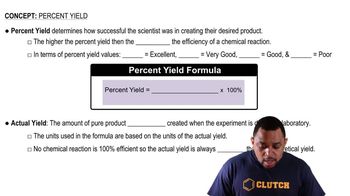
Percent Yield in Reactions

Actual Yield

Actual yield is the amount of product that is actually obtained from a chemical reaction, measured experimentally. It is often less than the theoretical yield due to various factors such as incomplete reactions, side reactions, and losses during product recovery. Understanding the difference between actual and theoretical yield is essential for evaluating the efficiency of a reaction.
Video consigliato:
Percorso guidato
03:09
Percent Yield in Reactions

Factors Affecting Yield

Several factors can affect the yield of a chemical reaction, including reaction conditions (temperature, pressure, concentration), the presence of catalysts, and the purity of reactants. Additionally, physical losses during the transfer and purification of products can contribute to a lower actual yield. Recognizing these factors helps chemists optimize reactions to improve yields.
Video consigliato:
Percorso guidato
01:21
Factors Affecting Entropy