
(b) Because atoms are spherical, they cannot occupy all of the space of the cube. The silver atoms pack in the solid in such a way that 74% of the volume of the solid is actually filled with the silver atoms. Calculate the volume of a single silver atom.
Ch.3 - Chemical Reactions and Reaction Stoichiometry
Brown14th EditionChemistry: The Central ScienceISBN: 9780134414232Non è quello che usi tu?Cambia libro di testo
Tutti i libri di testo
Brown 14th Edition
Ch.3 - Chemical Reactions and Reaction Stoichiometry
Problema 107
Brown 14th Edition
Ch.3 - Chemical Reactions and Reaction Stoichiometry
Problema 107Capitolo 3, Problema 107
Viridicatumtoxin B, C30H31NO10, is a natural antibiotic compound. It requires a synthesis of 12 steps in the laboratory. Assuming all steps have equivalent yields of 85%, which is the final percent yield of the total synthesis?
Guida verificata passo dopo passo1
Identify that the problem involves calculating the overall percent yield of a multi-step synthesis, where each step has an equivalent yield of 85%.
Recall that the overall yield of a multi-step process is the product of the yields of each individual step.
Express the yield of each step as a decimal: 85% becomes 0.85.
Since there are 12 steps, raise the yield of one step to the power of 12: \((0.85)^{12}\).
Convert the result back to a percentage by multiplying by 100 to find the final percent yield of the total synthesis.

Risposta video verificata per un problema simile:
Questa soluzione video è stata consigliata dai nostri tutor come utile per risolvere questo problema.
Durata del video:
51sConcetti chiave
Ecco i concetti essenziali che devi comprendere per rispondere correttamente alla domanda.
Percent Yield
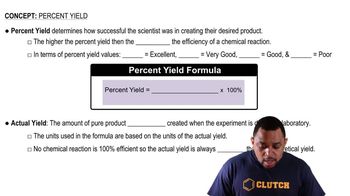
Percent yield is a measure of the efficiency of a chemical reaction, calculated as the ratio of the actual yield to the theoretical yield, multiplied by 100. It indicates how much product is obtained from a reaction compared to the maximum possible amount, helping chemists assess the effectiveness of their synthetic processes.
Video consigliato:
Percorso guidato
Percent Yield in Reactions
Sequential Reactions
In synthetic chemistry, sequential reactions refer to a series of chemical transformations where the product of one reaction serves as the reactant for the next. Each step can affect the overall yield, as the final product yield is influenced by the yields of all preceding steps, necessitating careful calculation of cumulative effects.
Video consigliato:
Percorso guidato
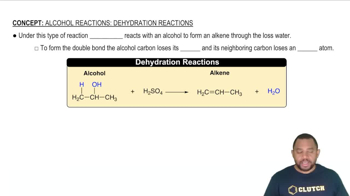
Alcohol Reactions: Dehydration Reactions
Multiplicative Yield Calculation
When dealing with multiple steps in a synthesis, the overall yield is calculated by multiplying the yields of each individual step. For example, if each step has a yield of 85%, the final yield is determined by raising the yield to the power of the number of steps, reflecting the compounding effect of losses at each stage.
Video consigliato:
Percorso guidato
Percent Yield in Reactions
Pratica correlata
Domanda del libro di testo
When a mixture of 10.0 g of acetylene (C2H2) and 10.0 g of oxygen (O2) is ignited, the resulting combustion reaction produces CO2 and H2O. (c) How many grams of C2H2 are present after the reaction is complete?
799
views
Domanda del libro di testo
Burning acetylene in oxygen can produce three different carbon-containing products: soot (very fine particles of graphite), CO(g), and CO2(g). (c) Why, when the oxygen supply is adequate, is CO2(g) the predominant carbon-containing product of the combustion of acetylene?
1216
views
Domanda del libro di testo
When a mixture of 10.0 g of acetylene (C2H2) and 10.0 g of oxygen (O2) is ignited, the resulting combustion reaction produces CO2 and H2O. (c) How many grams of CO2 and H2O are present after the reaction is complete?
394
views