Ch.3 - Chemical Reactions and Reaction Stoichiometry
Brown - Chemistry: The Central Science 14th Edition
Brown14th EditionChemistry: The Central ScienceISBN: 9780134414232Non è quello che usi tu?Cambia libro di testo
Capitolo 3, Problema 87c

Write balanced chemical equations for (c) the combination reaction between nickel metal and chlorine gas.

Guida verificata passo dopo passo
1
Identify the reactants: nickel metal (Ni) and chlorine gas (Cl_2).
Determine the product of the reaction: nickel chloride (NiCl_2), as nickel typically forms a +2 oxidation state.
Write the unbalanced chemical equation: Ni + Cl_2 \(\rightarrow\) NiCl_2.
Balance the equation by ensuring the number of atoms of each element is equal on both sides. Start by balancing the chlorine atoms.
Adjust the coefficients to balance the equation: Ni + Cl_2 \(\rightarrow\) NiCl_2 is already balanced.

Risposta video verificata per un problema simile:

Questa soluzione video è stata consigliata dai nostri tutor come utile per risolvere questo problema.
Durata del video:
1m

Concetti chiave

Ecco i concetti essenziali che devi comprendere per rispondere correttamente alla domanda.

Combination Reaction

A combination reaction, also known as a synthesis reaction, occurs when two or more reactants combine to form a single product. In this type of reaction, elements or simpler compounds react to create a more complex compound. For example, when nickel metal reacts with chlorine gas, they combine to form nickel(II) chloride.
Video consigliato:
Percorso guidato
01:43
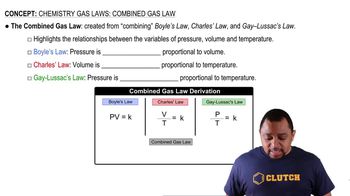
Combined Gas Law

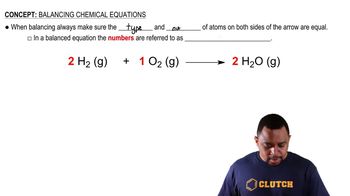
Balancing Chemical Equations

Balancing chemical equations is essential to ensure that the law of conservation of mass is upheld, meaning the number of atoms of each element must be the same on both sides of the equation. This involves adjusting coefficients in front of the reactants and products to achieve equal numbers of each type of atom. A balanced equation accurately represents the quantities of substances involved in the reaction.
Video consigliato:
Percorso guidato
01:32
Balancing Chemical Equations

Chemical Symbols and Formulas

Chemical symbols and formulas are shorthand representations of elements and compounds. Each element is represented by a one- or two-letter symbol, while compounds are represented by formulas that indicate the types and numbers of atoms present. For instance, nickel is denoted as 'Ni' and chlorine as 'Cl', while the compound formed from their reaction is represented as NiCl2, indicating one nickel atom and two chlorine atoms.
Video consigliato:
Percorso guidato
03:17
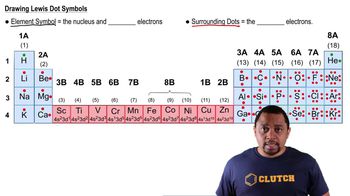
Lewis Dot Symbols
Pratica correlata
Domanda del libro di testo

If 2.0 mol CH3CH2CH2COOH, 2.0 mol C4H10, and 2.0 mol C6H6 are completely combusted in oxygen, which one produces the least? Explain.

385
views

Domanda del libro di testo

Hydrogen sulfide is an impurity in natural gas that must be removed. One common removal method is called the Claus process, which relies on the reaction: 8 H2S1g2 + 4 O21g2¡S81l2 + 8 H2O1g2 Under optimal conditions the Claus process gives 98% yield of S8 from H2S. If you started with 30.0 g of H2S and 50.0 g of O2, how many grams of S8 would be produced, assuming 98% yield?

1895
views
Domanda del libro di testo

If 2.0 mol CH3CH2CH2COOH, 2.0 mol C4H10, and 2.0 mol C6H6 are completely combusted in oxygen, which one produces the largest number of moles of H2O?

452
views
Domanda del libro di testo

When hydrogen sulfide gas is bubbled into a solution of sodium hydroxide, the reaction forms sodium sulfide and water. How many grams of sodium sulfide are formed if 1.25 g of hydrogen sulfide is bubbled into a solution containing 2.00 g of sodium hydroxide, assuming that the sodium sulfide is made in 92.0% yield?

2678
views
Domanda del libro di testo

Write balanced chemical equations for (a) the complete combustion of acetone (CH3COCH3), a common organic solvent (b) the decomposition of solid mercury (I) carbonate into carbon dioxide gas, mercury, and solid mercury oxide

1077
views
Domanda del libro di testo
Calcium is an essential nutrient in our body. It is important for bone health. Four common calcium-containing supplements are calcium carbonate (CaCO3), calcium citrate (Ca3C12H10O14), calcium gluconate (CaC12H22O14), and calcium lactate (CaC6H10O6). Rank these calcium supplements in terms of the mass percentage of calcium they contain.
778
views