Ch.3 - Chemical Reactions and Reaction Stoichiometry
Brown - Chemistry: The Central Science 14th Edition
Brown14th EditionChemistry: The Central ScienceISBN: 9780134414232Non è quello che usi tu?Cambia libro di testo
Capitolo 3, Problema 88a

If 2.0 mol CH3CH2CH2COOH, 2.0 mol C4H10, and 2.0 mol C6H6 are completely combusted in oxygen, which one produces the largest number of moles of H2O?

Guida verificata passo dopo passo
1
Identify the chemical formulas for each compound: CH3CH2CH2COOH (butanoic acid), C4H10 (butane), and C6H6 (benzene).
Write the balanced chemical equation for the complete combustion of each compound. For example, the combustion of butanoic acid is: \[ \text{CH}_3\text{CH}_2\text{CH}_2\text{COOH} + \frac{9}{2} \text{O}_2 \rightarrow 4 \text{CO}_2 + 4 \text{H}_2\text{O} \]
Determine the number of moles of water produced per mole of each compound combusted. For butanoic acid, 4 moles of water are produced per mole of acid.
Calculate the total moles of water produced by multiplying the moles of each compound by the moles of water produced per mole of compound. For example, for butanoic acid: \(2.0 \text{ mol} \times 4 \text{ mol H}_2\text{O/mol} = 8 \text{ mol H}_2\text{O}\).
Compare the total moles of water produced by each compound to determine which one produces the largest number of moles of water.

Risposta video verificata per un problema simile:

Questa soluzione video è stata consigliata dai nostri tutor come utile per risolvere questo problema.
Durata del video:
9m

Concetti chiave

Ecco i concetti essenziali che devi comprendere per rispondere correttamente alla domanda.

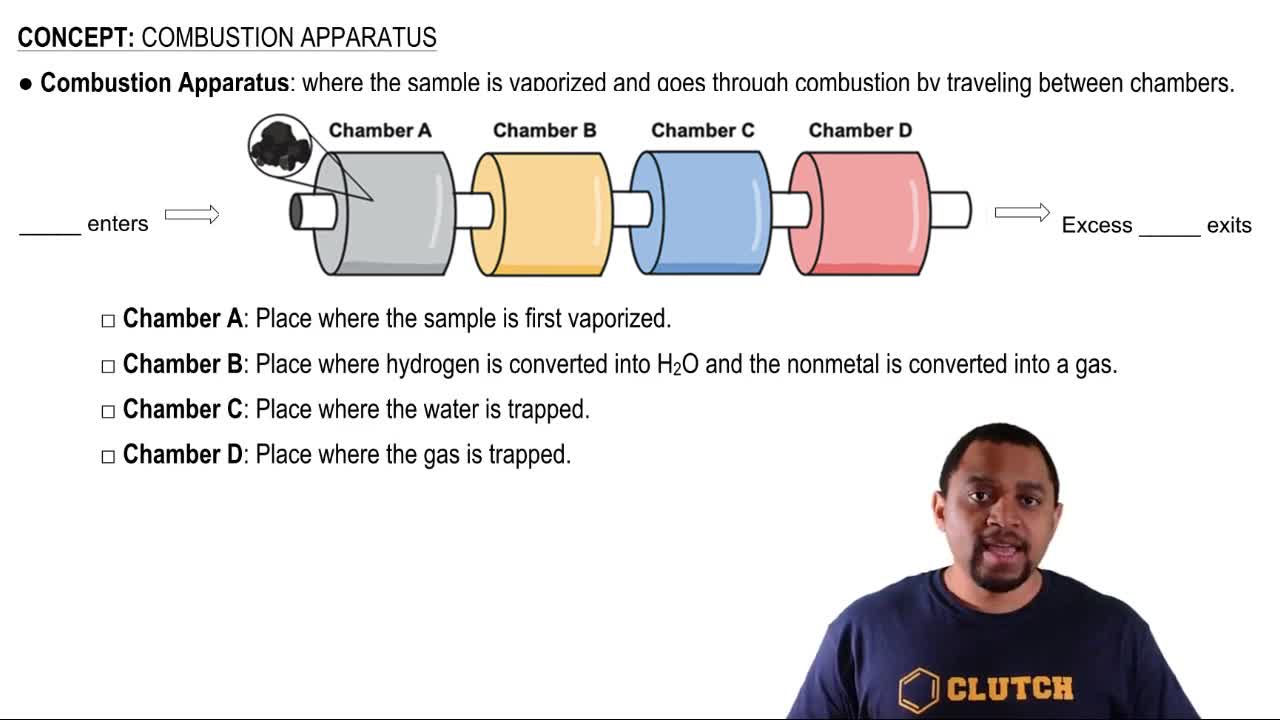
Combustion Reaction

A combustion reaction is a chemical process in which a substance reacts with oxygen to produce heat and light. In organic compounds, this typically results in the formation of carbon dioxide and water. Understanding the stoichiometry of combustion reactions is essential for determining the products and their quantities, particularly when comparing different substances.
Video consigliato:
Percorso guidato
02:24
Combustion Apparatus

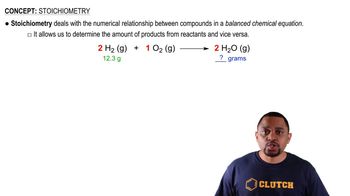
Stoichiometry

Stoichiometry is the calculation of reactants and products in chemical reactions based on the balanced chemical equation. It allows us to determine the mole ratios of substances involved in the reaction, which is crucial for predicting how many moles of water will be produced from the combustion of each hydrocarbon in the question.
Video consigliato:
Percorso guidato
01:16
Stoichiometry Concept

Molar Mass and Molecular Formula

The molar mass and molecular formula of a compound provide information about the number of atoms of each element in a molecule. For hydrocarbons like CH3CH2CH2COOH, C4H10, and C6H6, knowing their molecular formulas helps in calculating the total number of moles of water produced during combustion, as the number of hydrogen atoms directly influences the amount of water formed.
Video consigliato:
Percorso guidato
02:11
Molar Mass Concept
Pratica correlata
Domanda del libro di testo

If 2.0 mol CH3CH2CH2COOH, 2.0 mol C4H10, and 2.0 mol C6H6 are completely combusted in oxygen, which one produces the least? Explain.

385
views

Domanda del libro di testo

When hydrogen sulfide gas is bubbled into a solution of sodium hydroxide, the reaction forms sodium sulfide and water. How many grams of sodium sulfide are formed if 1.25 g of hydrogen sulfide is bubbled into a solution containing 2.00 g of sodium hydroxide, assuming that the sodium sulfide is made in 92.0% yield?

2678
views
Domanda del libro di testo

Write balanced chemical equations for (a) the complete combustion of acetone (CH3COCH3), a common organic solvent (b) the decomposition of solid mercury (I) carbonate into carbon dioxide gas, mercury, and solid mercury oxide

1077
views
Domanda del libro di testo

Write balanced chemical equations for (c) the combination reaction between nickel metal and chlorine gas.

464
views
Domanda del libro di testo
Calcium is an essential nutrient in our body. It is important for bone health. Four common calcium-containing supplements are calcium carbonate (CaCO3), calcium citrate (Ca3C12H10O14), calcium gluconate (CaC12H22O14), and calcium lactate (CaC6H10O6). Rank these calcium supplements in terms of the mass percentage of calcium they contain.
778
views
Domanda del libro di testo

(a) Ibuprofen is a common over-the-counter analgesic with the formula C13H18O2. How many moles of C13H18O2 are in a 500-mg tablet of ibuprofen? Assume the tablet is composed entirely of ibuprofen.