Ch.4 - Reactions in Aqueous Solution
Brown - Chemistry: The Central Science 14th Edition
Brown14th EditionChemistry: The Central ScienceISBN: 9780134414232Non è quello che usi tu?Cambia libro di testo
Capitolo 4, Problema 89

A 0.5895-g sample of impure magnesium hydroxide is dissolved in 100.0 mL of 0.2050 M HCl solution. The excess acid then needs 19.85 mL of 0.1020 M NaOH for neutralization. Calculate the percentage by mass of magnesium hydroxide in the sample, assuming that it is the only substance reacting with the HCl solution.

Guida verificata passo dopo passo
1
Calculate the moles of HCl initially present using the concentration and volume: \( \text{moles of HCl} = 0.2050 \, \text{M} \times 0.1000 \, \text{L} \).
Calculate the moles of NaOH used in the neutralization of excess HCl: \( \text{moles of NaOH} = 0.1020 \, \text{M} \times 0.01985 \, \text{L} \).
Since NaOH neutralizes the excess HCl in a 1:1 ratio, the moles of excess HCl are equal to the moles of NaOH used.
Subtract the moles of excess HCl from the initial moles of HCl to find the moles of HCl that reacted with magnesium hydroxide.
Use the stoichiometry of the reaction \( \text{Mg(OH)}_2 + 2\text{HCl} \rightarrow \text{MgCl}_2 + 2\text{H}_2\text{O} \) to find the moles of \( \text{Mg(OH)}_2 \) that reacted, then calculate the mass of \( \text{Mg(OH)}_2 \) and determine the percentage by mass in the sample.

Risposta video verificata per un problema simile:

Questa soluzione video è stata consigliata dai nostri tutor come utile per risolvere questo problema.
Durata del video:
12m

Concetti chiave

Ecco i concetti essenziali che devi comprendere per rispondere correttamente alla domanda.

Stoichiometry

Stoichiometry is the calculation of reactants and products in chemical reactions based on the balanced chemical equation. It allows us to determine the amount of a substance consumed or produced in a reaction. In this question, stoichiometry is essential for relating the moles of HCl reacted with magnesium hydroxide to the moles of NaOH used for neutralization.
Video consigliato:
Percorso guidato
01:16
Stoichiometry Concept

Molarity

Molarity is a measure of concentration defined as the number of moles of solute per liter of solution. It is crucial for calculating the amount of acid and base involved in the reaction. In this problem, the molarity of HCl and NaOH solutions is used to find the moles of each reactant, which are necessary for determining the mass percentage of magnesium hydroxide.
Video consigliato:

Mass Percentage

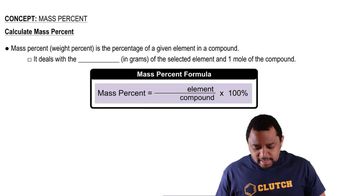
Mass percentage is a way of expressing the concentration of a component in a mixture, calculated as the mass of the component divided by the total mass of the mixture, multiplied by 100. In this scenario, calculating the mass percentage of magnesium hydroxide involves determining the mass of magnesium hydroxide that reacted with HCl and comparing it to the total mass of the impure sample.
Video consigliato:
Percorso guidato
00:38
Mass Percent Calculation
Pratica correlata
Domanda del libro di testo

The accompanying photo shows the reaction between a solution of Cd(NO3)2 and one of Na2S. (b) What ions remain in solution?

354
views

Domanda del libro di testo

A solution is made by mixing 1.5 g of LiOH and 23.5 mL of 1.000 M HNO3. (b) Calculate the concentration of each ion remaining in solution.

588
views
Domanda del libro di testo

A solution is made by mixing 1.5 g of Sr(OH)2 and 23.5 mL of 1.000 M HNO3. (c) Is the resulting solution acidic or basic?

415
views
Domanda del libro di testo

A 1.248-g sample of limestone rock is pulverized and then treated with 30.00 mL of 1.035 M HCl solution. The excess acid then requires 11.56 mL of 1.010 M NaOH for neutralization. Calculate the percentage by mass of calcium carbonate in the rock, assuming that it is the only substance reacting with the HCl solution.

1098
views
Domanda del libro di testo

Uranium hexafluoride, UF6, is processed to produce fuel for nuclear reactors and nuclear weapons. UF6 can be produced in a two-step reaction. Solid uranium (IV) oxide, UO2, is first made to react with hydrofluoric acid (HF) solution to form solid UF4 with water as a by-product. UF4 further reacts with fluorine gas to form UF6. (a) Write the balanced molecular equations for the conversion of UO2 into UF4 and the conversion of UF4 to UF6. (b) Which step is an acid-base reaction?

931
views
Domanda del libro di testo

A solution of 100.0 mL of 0.200 M KOH is mixed with a solution of 200.0 mL of 0.150 M NiSO4. (e) What is the concentration of each ion that remains in solution?

998
views