
Ch.4 - Reactions in Aqueous Solution
Brown - Chemistry: The Central Science 14th Edition
Brown14th EditionChemistry: The Central ScienceISBN: 9780134414232Non è quello che usi tu?Cambia libro di testo
Capitolo 4, Problema 20a3

Acetone, CH3COCH3, is a nonelectrolyte; hypochlorous acid, HClO, is a weak electrolyte; and ammonium chloride, NH4Cl, is a strong electrolyte. (a) What are the solutes present in aqueous solutions of each compound? What solute particles are present in an aqueous solution of NH4Cl?

Guida verificata passo dopo passo
1
1. The solutes present in an aqueous solution are the substances that are dissolved in the water. In this case, the solutes are acetone (CH3COCH3), hypochlorous acid (HClO), and ammonium chloride (NH4Cl).
2. For acetone, which is a nonelectrolyte, it does not ionize in water. Therefore, the solute particles present in an aqueous solution of acetone are simply acetone molecules (CH3COCH3).
3. For hypochlorous acid, which is a weak electrolyte, it partially ionizes in water. Therefore, the solute particles present in an aqueous solution of hypochlorous acid are mainly un-ionized hypochlorous acid molecules (HClO), and a small amount of hydronium ions (H3O+) and hypochlorite ions (ClO-).
4. For ammonium chloride, which is a strong electrolyte, it completely ionizes in water. Therefore, the solute particles present in an aqueous solution of ammonium chloride are ammonium ions (NH4+) and chloride ions (Cl-).
5. To summarize, the solute particles present in an aqueous solution depend on whether the solute is a nonelectrolyte, weak electrolyte, or strong electrolyte. Nonelectrolytes do not ionize and exist as whole molecules in solution, weak electrolytes partially ionize, and strong electrolytes completely ionize into their constituent ions.

Risposta video verificata per un problema simile:

Questa soluzione video è stata consigliata dai nostri tutor come utile per risolvere questo problema.
Durata del video:
1m

Concetti chiave

Ecco i concetti essenziali che devi comprendere per rispondere correttamente alla domanda.

Electrolytes and Nonelectrolytes

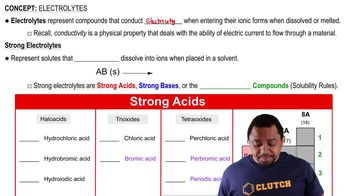
Electrolytes are substances that dissociate into ions when dissolved in water, allowing the solution to conduct electricity. Strong electrolytes, like ammonium chloride (NH4Cl), completely dissociate into their constituent ions, while weak electrolytes, such as hypochlorous acid (HClO), only partially dissociate. Nonelectrolytes, like acetone (CH3COCH3), do not dissociate into ions in solution and therefore do not conduct electricity.
Video consigliato:
Percorso guidato
02:50
Electrolytes and Strong Acids

Dissociation of Ionic Compounds

When ionic compounds dissolve in water, they undergo dissociation, breaking apart into their individual ions. For example, NH4Cl dissociates into NH4+ and Cl- ions in solution. This process is crucial for understanding the behavior of electrolytes in aqueous solutions, as the presence of free ions is what enables conductivity and affects chemical reactivity.
Video consigliato:
Percorso guidato
02:11
Ionic Compounds Naming

Weak vs. Strong Electrolytes

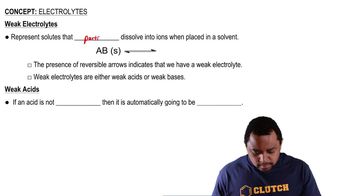
The distinction between weak and strong electrolytes is based on the extent of ionization in solution. Strong electrolytes, like NH4Cl, fully ionize, resulting in a high concentration of ions. In contrast, weak electrolytes, such as HClO, only partially ionize, leading to a lower concentration of ions. This difference impacts the properties of the solution, including its conductivity and pH.
Video consigliato:
Percorso guidato
00:55
Weak Electrolytes and Weak Acids