
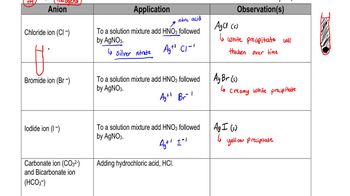
You are presented with a white solid and told that due to careless labeling it is not clear if the substance is barium chloride, lead chloride, or zinc chloride. When you transfer the solid to a beaker and add water, the solid dissolves to give a clear solution. Next an Na2SO41aq2 solution is added and a white precipitate forms. What is the identity of the unknown white solid?
Ch.4 - Reactions in Aqueous Solution
Brown14th EditionChemistry: The Central ScienceISBN: 9780134414232Non è quello che usi tu?Cambia libro di testo
Capitolo 4, Problema 2
Aqueous solutions of three different substances, AX, AY, and AZ, are represented by the three accompanying diagrams. Identify each substance as a strong electrolyte, a weak electrolyte, or a nonelectrolyte.
Guida verificata passo dopo passo1
Identify the characteristics of strong electrolytes, weak electrolytes, and nonelectrolytes.
Examine the diagrams to determine the degree of ionization or dissociation of each substance in solution.
For a strong electrolyte, look for complete dissociation into ions in the diagram.
For a weak electrolyte, look for partial dissociation, with some molecules remaining intact.
For a nonelectrolyte, look for no dissociation, with all molecules remaining intact in the solution.

Risposta video verificata per un problema simile:
Questa soluzione video è stata consigliata dai nostri tutor come utile per risolvere questo problema.
Durata del video:
1mConcetti chiave
Ecco i concetti essenziali che devi comprendere per rispondere correttamente alla domanda.
Electrolytes
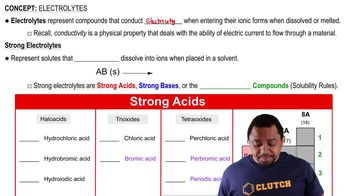
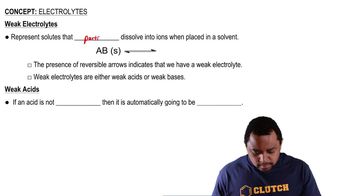
Electrolytes are substances that dissociate into ions when dissolved in water, allowing the solution to conduct electricity. They can be classified into strong electrolytes, which completely dissociate into ions, weak electrolytes, which partially dissociate, and nonelectrolytes, which do not dissociate at all. Understanding these classifications is crucial for analyzing the conductivity of solutions.
Video consigliato:
Percorso guidato
Electrolytes and Strong Acids
Strong vs. Weak Electrolytes
Strong electrolytes, such as sodium chloride, fully ionize in solution, resulting in high conductivity. In contrast, weak electrolytes, like acetic acid, only partially ionize, leading to lower conductivity. Recognizing the differences in ionization behavior helps in determining the nature of the substances AX, AY, and AZ in the given question.
Video consigliato:
Percorso guidato
Weak Electrolytes and Weak Acids
Conductivity Testing
The conductivity of an aqueous solution is a practical method to identify electrolytes. Solutions with high conductivity indicate the presence of strong electrolytes, while low conductivity suggests weak electrolytes or nonelectrolytes. By observing the conductivity of the solutions represented in the diagrams, one can classify AX, AY, and AZ accordingly.
Video consigliato:
Percorso guidato
Test for Anions
Pratica correlata
Domanda del libro di testo
430
views
Domanda del libro di testo
Use the molecular representations shown here to classify each compound as a nonelectrolyte, a weak electrolyte, or a strong electrolyte (see Figure 4.6 for the element color scheme). (a)
709
views
Domanda del libro di testo
The concept of chemical equilibrium is very important. Which one of the following statements is the most correct way to think about equilibrium? (a) If a system is at equilibrium, nothing is happening. (b) If a system is at equilibrium, the rate of the forward reaction is equal to the rate of the back reaction. (c) If a system is at equilibrium, the product concentration is changing over time.
1037
views
Domanda del libro di testo
Which of the following schematic drawings best describes a solution of Li2SO4 in water (water molecules not shown for simplicity)?
1261
views
