
Ch.4 - Reactions in Aqueous Solution
Brown - Chemistry: The Central Science 14th Edition
Brown14th EditionChemistry: The Central ScienceISBN: 9780134414232Non è quello che usi tu?Cambia libro di testo
Capitolo 4, Problema 3

Use the molecular representations shown here to classify each compound as a nonelectrolyte, a weak electrolyte, or a strong electrolyte (see Figure 4.6 for the element color scheme). (a)
Molecular models of three compounds for classifying electrolytes in chemistry.

Guida verificata passo dopo passo
1
Identify the molecular structures shown in the image. The first molecule has a central green atom surrounded by four red atoms, indicating it is likely a chlorate ion (ClO4-). The second molecule has a central carbon atom bonded to an oxygen atom and two hydrogen atoms, indicating it is ethanol (C2H5OH). The third molecule has two oxygen atoms bonded to two hydrogen atoms, indicating it is water (H2O).
Determine the nature of each compound in terms of its ability to dissociate in water. Strong electrolytes completely dissociate into ions, weak electrolytes partially dissociate, and nonelectrolytes do not dissociate.
Classify the first compound (chlorate ion, ClO4-). Since it is an ion, it will completely dissociate in water, making it a strong electrolyte.
Classify the second compound (ethanol, C2H5OH). Ethanol does not dissociate into ions in water, making it a nonelectrolyte.
Classify the third compound (water, H2O). Water itself is a very weak electrolyte because it only slightly dissociates into H+ and OH- ions.

Risposta video verificata per un problema simile:

Questa soluzione video è stata consigliata dai nostri tutor come utile per risolvere questo problema.
Durata del video:
1m

Concetti chiave

Ecco i concetti essenziali che devi comprendere per rispondere correttamente alla domanda.

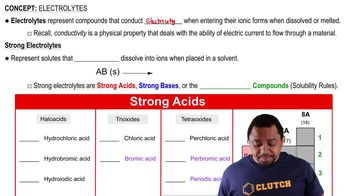
Electrolytes

Electrolytes are substances that dissociate into ions when dissolved in water, allowing the solution to conduct electricity. They are classified into three categories: strong electrolytes, which completely dissociate into ions; weak electrolytes, which partially dissociate; and nonelectrolytes, which do not dissociate at all. Understanding the behavior of these substances in solution is crucial for predicting their electrical conductivity and reactivity.
Video consigliato:
Percorso guidato
02:50
Electrolytes and Strong Acids

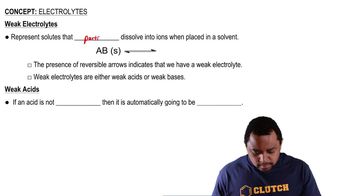
Strong vs. Weak Electrolytes

Strong electrolytes, such as sodium chloride, fully ionize in solution, resulting in a high concentration of ions and strong conductivity. In contrast, weak electrolytes, like acetic acid, only partially ionize, leading to a lower concentration of ions and weaker conductivity. The degree of ionization is influenced by the chemical structure and the nature of the solute, which is essential for classifying the compounds shown in the image.
Video consigliato:
Percorso guidato
00:55
Weak Electrolytes and Weak Acids

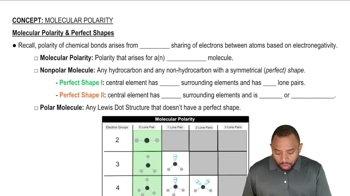
Molecular Structure and Polarity

The molecular structure and polarity of a compound significantly affect its classification as an electrolyte. Polar molecules tend to dissolve in water and can ionize, while nonpolar molecules do not interact well with water and typically remain intact. Analyzing the molecular representations in the image helps determine the polarity and potential ionization of each compound, guiding their classification as nonelectrolytes, weak electrolytes, or strong electrolytes.
Video consigliato:
Percorso guidato
02:38
Molecular Polarity