Indicate the concentration of each ion present in the solution formed by mixing: (b) 44.0 mL of 0.100 M Na2SO4 with 25.0 mL of 0.150 M KCl
Ch.4 - Reactions in Aqueous Solution
Brown14th EditionChemistry: The Central ScienceISBN: 9780134414232Non è quello che usi tu?Cambia libro di testo
Capitolo 4, Problema 71d
Ignoring protolysis reactions, indicate the concentration of each ion or molecule present in the following solutions: (d) a mixture of 45.0 mL of 0.272 M NaCl and 65.0 mL of 0.0247 M (NH4)2CO3. Assume that the volumes are additive.
Guida verificata passo dopo passo1
Calculate the total volume of the solution by adding the volumes of the NaCl and (NH4)2CO3 solutions. This is done by adding 45.0 mL and 65.0 mL.
Calculate the moles of NaCl initially present using its concentration and the volume of the NaCl solution. Use the formula: moles = concentration (M) imes volume (L).
Calculate the moles of (NH4)2CO3 initially present using its concentration and the volume of the (NH4)2CO3 solution. Use the same formula as in step 2.
Determine the concentration of each ion in the final solution. For NaCl, which dissociates into Na+ and Cl-, the concentration of each ion is equal to the total moles of NaCl divided by the total volume of the solution. For (NH4)2CO3, which dissociates into 2NH4+ and CO32-, the concentration of NH4+ is twice the moles of (NH4)2CO3 divided by the total volume, and the concentration of CO32- is equal to the moles of (NH4)2CO3 divided by the total volume.
Summarize the concentrations of Na+, Cl-, NH4+, and CO32- in the final solution.

Risposta video verificata per un problema simile:
Questa soluzione video è stata consigliata dai nostri tutor come utile per risolvere questo problema.
Durata del video:
3mConcetti chiave
Ecco i concetti essenziali che devi comprendere per rispondere correttamente alla domanda.
Concentration and Molarity
Concentration refers to the amount of solute present in a given volume of solution, commonly expressed in molarity (M), which is moles of solute per liter of solution. Understanding how to calculate molarity is essential for determining the concentration of ions or molecules in a mixture.
Video consigliato:
Percorso guidato
Molarity Concept
Dilution and Mixing Solutions
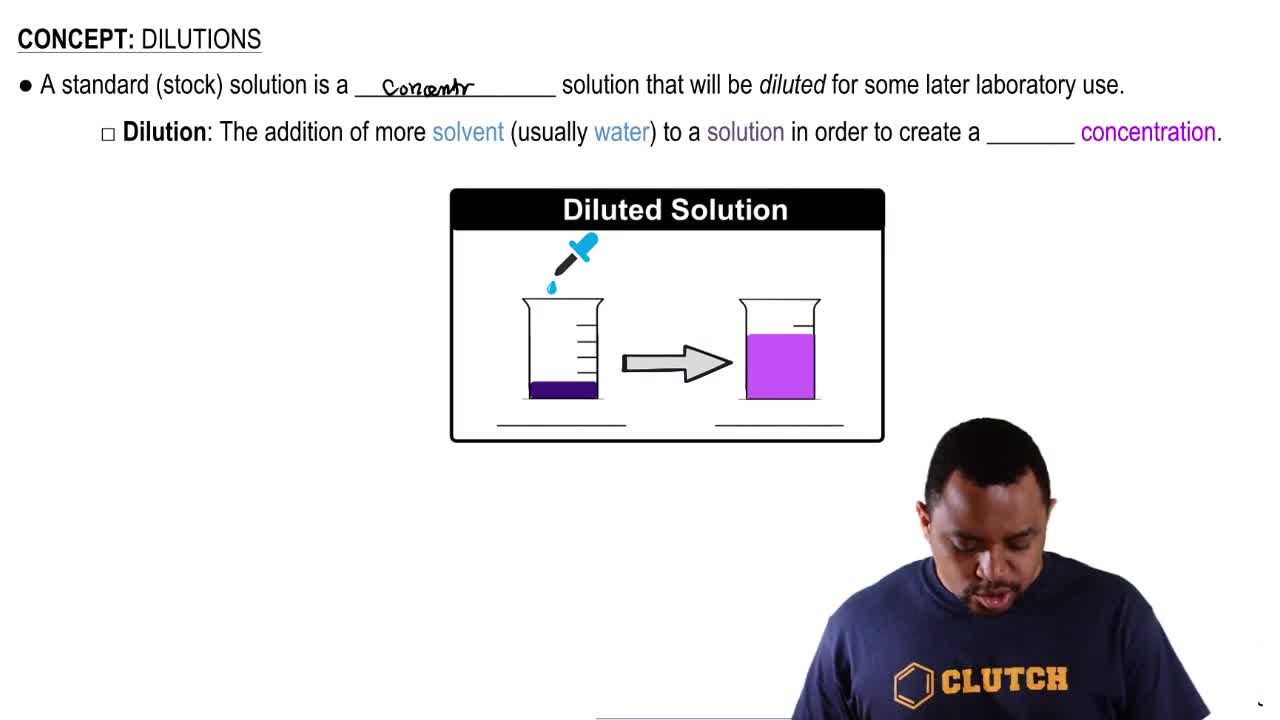
When two solutions are mixed, the total volume increases, and the concentrations of the solutes change. The final concentration can be calculated using the formula C1V1 + C2V2 = CfinalVfinal, where C is concentration and V is volume. This principle is crucial for accurately determining the concentrations of ions in the resulting solution.
Video consigliato:
Percorso guidato
Solution Dilution Process
Ionic Dissociation
Ionic compounds, such as NaCl, dissociate into their constituent ions when dissolved in water. For example, NaCl dissociates into Na⁺ and Cl⁻ ions. Understanding how different compounds dissociate is vital for calculating the concentrations of individual ions in a mixed solution.
Video consigliato:
Percorso guidato
Ionic Salts
Pratica correlata
Domanda del libro di testo
558
views
Domanda del libro di testo
(a) Which will have the highest concentration of potassium ions: 0.20 M KCl, 0.15 M K2CrO4, or 0.080 M K3PO4?
1459
views
Domanda del libro di testo
Indicate the concentration of each ion present in the solution formed by mixing: (c) 3.60 g KCl in 75.0 mL of 0.250 M CaCl2 solution. Assume that the volumes are additive.
490
views
Domanda del libro di testo
Indicate the concentration of each ion or molecule present in the following solutions: (a) 0.35 M K3PO4 (b) 1.3×10⁻² M MgSO4 (c) 0.0184 M CH3CH2OH
330
views
Domanda del libro di testo
Indicate the concentration of each ion present in the solution formed by mixing: (a) 42.0 mL of 0.170 M NaOH with 37.6 mL of 0.400 M NaOH.
1847
views
Domanda del libro di testo
(b) Which will contain the greater number of moles of potassium ion: 30.0 mL of 0.15 M K2CrO4 or 25.0 mL of 0.080 M K3PO4
407
views