
Ch.4 - Reactions in Aqueous Solution
Brown - Chemistry: The Central Science 14th Edition
Brown14th EditionChemistry: The Central ScienceISBN: 9780134414232Non è quello che usi tu?Cambia libro di testo
Capitolo 4, Problema 35c

Label each of the following substances as an acid, base, salt, or none of the above. Indicate whether the substance exists in aqueous solution entirely in molecular form, entirely as ions, or as a mixture of molecules and ions. (c) NaClO4

Guida verificata passo dopo passo
1
Identify the type of compound: NaClO4 is a salt because it is composed of a cation (Na+) and an anion (ClO4-).
Determine the solubility: NaClO4 is known to be soluble in water.
Analyze the dissociation in water: When NaClO4 dissolves in water, it dissociates completely into its ions, Na+ and ClO4-.
Conclude the state in solution: Since NaClO4 dissociates completely into ions in an aqueous solution, it exists entirely as ions.
Label the substance accordingly: NaClO4 is a salt and exists in aqueous solution entirely as ions.

Risposta video verificata per un problema simile:

Questa soluzione video è stata consigliata dai nostri tutor come utile per risolvere questo problema.
Durata del video:
2m

Concetti chiave

Ecco i concetti essenziali che devi comprendere per rispondere correttamente alla domanda.

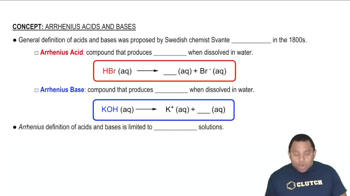
Acids and Bases

Acids are substances that donate protons (H+) in a solution, while bases accept protons. The Brønsted-Lowry theory defines acids and bases based on proton transfer, whereas the Lewis theory defines them based on electron pair donation and acceptance. Understanding these definitions is crucial for classifying substances correctly.
Video consigliato:
Percorso guidato
02:00
Arrhenius Acids and Bases

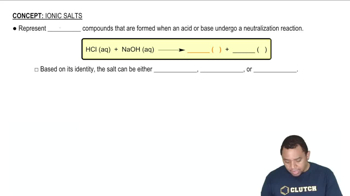
Salts

Salts are ionic compounds formed from the neutralization reaction between an acid and a base. They consist of cations and anions, and in aqueous solution, they typically dissociate into their constituent ions. Recognizing NaClO4 as a salt helps in determining its behavior in solution.
Video consigliato:

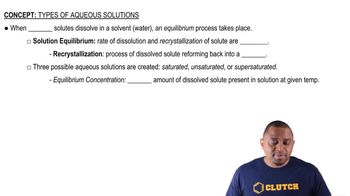
Aqueous Solutions and Dissociation

In aqueous solutions, substances can exist as molecules, ions, or a combination of both. Strong electrolytes, like NaClO4, dissociate entirely into ions, while weak electrolytes partially dissociate. Understanding the dissociation behavior of salts in water is essential for predicting their properties in solution.
Video consigliato:
Percorso guidato
01:11
Types of Aqueous Solutions
Pratica correlata
Domanda del libro di testo

Label each of the following substances as an acid, base, salt, or none of the above. Indicate whether the substance exists in aqueous solution entirely in molecular form, entirely as ions, or as a mixture of molecules and ions. (d) Ba1OH22.

949
views
Domanda del libro di testo

State whether each of the following statements is true or false. Justify your answer in each case.

(c) Although sulfuric acid is a strong electrolyte, an aqueous solution of H2SO4 contains more HSO4- ions than SO42- ions.

1108
views
1
comments
Domanda del libro di testo

Label each of the following substances as an acid, base, salt, or none of the above. Indicate whether the substance exists in aqueous solution entirely in molecular form, entirely as ions, or as a mixture of molecules and ions. (a) HF

390
views
Domanda del libro di testo

Label each of the following substances as an acid, base, salt, or none of the above. Indicate whether the substance exists in aqueous solution entirely in molecular form, entirely as ions, or as a mixture of molecules and ions. (b) acetonitrile, CH3CN

587
views
Domanda del libro di testo

An aqueous solution of an unknown solute is tested with litmus paper and found to be acidic. The solution is weakly conducting compared with a solution of NaCl of the same concentration. Which of the following substances could the unknown be: KOH, NH3, HNO3, KClO2, H3PO3, CH3COCH3 (acetone)?

1316
views
Domanda del libro di testo

Classify each of the following substances as a nonelectrolyte, weak electrolyte, or strong electrolyte in water: (a) HF (b) C6H5COOH (benzoic acid) (c) C6H6 (benzene) (d) CoCl3 (e) AgNO3.

755
views