
Ch.4 - Reactions in Aqueous Solution
Brown - Chemistry: The Central Science 14th Edition
Brown14th EditionChemistry: The Central ScienceISBN: 9780134414232Non è quello che usi tu?Cambia libro di testo
Capitolo 4, Problema 35d

Label each of the following substances as an acid, base, salt, or none of the above. Indicate whether the substance exists in aqueous solution entirely in molecular form, entirely as ions, or as a mixture of molecules and ions. (d) Ba1OH22.

Guida verificata passo dopo passo
1
Identify the chemical formula and structure of the substance given: Ba(OH)2, which is barium hydroxide.
Classify the substance based on its chemical structure. Ba(OH)2 contains OH- (hydroxide) groups, which are characteristic of bases.
Determine the nature of the substance in aqueous solution. Ba(OH)2 is a strong base and dissociates completely into Ba2+ and OH- ions in water.
Conclude that Ba(OH)2 is a base and exists entirely as ions (Ba2+ and OH-) when dissolved in water.
Label the substance accordingly: Ba(OH)2 is a base and exists entirely as ions in aqueous solution.

Risposta video verificata per un problema simile:

Questa soluzione video è stata consigliata dai nostri tutor come utile per risolvere questo problema.
Durata del video:
1m

Concetti chiave

Ecco i concetti essenziali che devi comprendere per rispondere correttamente alla domanda.

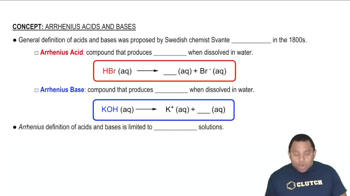
Acids and Bases

Acids are substances that donate protons (H+) in a solution, while bases accept protons. The Brønsted-Lowry theory defines acids and bases based on proton transfer, whereas the Lewis theory expands this definition to include electron pair acceptors and donors. Understanding these definitions is crucial for classifying substances correctly.
Video consigliato:
Percorso guidato
02:00
Arrhenius Acids and Bases

Ionic and Molecular Compounds

Ionic compounds consist of charged ions held together by electrostatic forces, while molecular compounds are formed by covalent bonds between atoms. In aqueous solutions, ionic compounds dissociate into their constituent ions, whereas molecular compounds typically remain intact. This distinction is essential for determining the form in which a substance exists in solution.
Video consigliato:
Percorso guidato
02:11
Ionic Compounds Naming

Solubility and Aqueous Solutions

Solubility refers to the ability of a substance to dissolve in a solvent, such as water. When a substance dissolves, it can exist as ions, molecules, or a combination of both, depending on its chemical nature. Recognizing how different substances behave in aqueous solutions helps in identifying their classification as acids, bases, or salts.
Video consigliato:
Percorso guidato
01:11
Types of Aqueous Solutions