
Ch.4 - Reactions in Aqueous Solution
Brown - Chemistry: The Central Science 14th Edition
Brown14th EditionChemistry: The Central ScienceISBN: 9780134414232Non è quello che usi tu?Cambia libro di testo
Capitolo 4, Problema 58b

The following reactions (note that the arrows are pointing only one direction) can be used to prepare an activity series for the halogens:
Br2(aq) + 2 NaI(aq) → 2 NaBr(aq) + I2(aq)
Cl2(aq) + 2 NaBr(aq) → 2 NaCl(aq) + Br2(aq)
(b) Predict whether a reaction will occur when elemental chlorine and potassium iodide are mixed.

Guida verificata passo dopo passo
1
Step 1: Understand the concept of an activity series. An activity series is a list of elements organized by their ability to displace other elements in a compound. For halogens, the activity series is based on their ability to act as oxidizing agents.
Step 2: Analyze the given reactions to determine the relative reactivity of the halogens involved. In the first reaction, bromine (Br2) displaces iodine (I2) from sodium iodide (NaI), indicating that bromine is more reactive than iodine. In the second reaction, chlorine (Cl2) displaces bromine from sodium bromide (NaBr), indicating that chlorine is more reactive than bromine.
Step 3: Establish the activity series for the halogens based on the reactions: Cl2 > Br2 > I2. This means chlorine is the most reactive, followed by bromine, and then iodine.
Step 4: Apply the activity series to predict the outcome of mixing elemental chlorine (Cl2) with potassium iodide (KI). Since chlorine is more reactive than iodine, it can displace iodine from potassium iodide, leading to a chemical reaction.
Step 5: Write the balanced chemical equation for the predicted reaction: Cl2(aq) + 2 KI(aq) → 2 KCl(aq) + I2(aq). This equation shows chlorine displacing iodine from potassium iodide, forming potassium chloride and iodine.

Risposta video verificata per un problema simile:

Questa soluzione video è stata consigliata dai nostri tutor come utile per risolvere questo problema.
Durata del video:
4m

Concetti chiave

Ecco i concetti essenziali che devi comprendere per rispondere correttamente alla domanda.

Activity Series

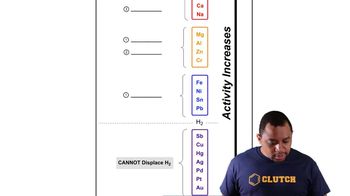
The activity series is a list of elements organized by their ability to displace other elements in reactions, particularly in single displacement reactions. In the context of halogens, the series ranks them from most reactive to least reactive, with fluorine being the most reactive and iodine the least. Understanding this series helps predict whether a reaction will occur when two halogens are involved.
Video consigliato:
Percorso guidato
02:02
Activity Series Chart

Single Displacement Reaction

A single displacement reaction occurs when an element reacts with a compound and displaces another element from that compound. In the case of halogens, a more reactive halogen can displace a less reactive halogen from its compound. This concept is crucial for predicting the outcome of reactions involving halogens, such as the one between chlorine and potassium iodide.
Video consigliato:
Percorso guidato
01:11
Single Displacement Reactions

Reactivity of Halogens

Halogens are a group of elements in Group 17 of the periodic table, known for their high reactivity, particularly in forming compounds. Their reactivity decreases down the group, meaning fluorine is the most reactive, followed by chlorine, bromine, and iodine. This trend is essential for predicting whether chlorine will react with potassium iodide, as it is more reactive than iodine and can displace it.
Video consigliato:
Percorso guidato
01:11
Halogenation Reactions
Pratica correlata
Domanda del libro di testo

You make 1.000 L of an aqueous solution that contains 35.0 g of sucrose (C12H22O11). (b) How many liters of water would you have to add to this solution to reduce the molarity you calculated in part (a) by a factor of two?

933
views
Domanda del libro di testo

(a) Is the number of moles of ions present in a solution an intensive or an extensive property?

448
views
Domanda del libro di testo

The following reactions (note that the arrows are pointing only one direction) can be used to prepare an activity series for the halogens:

Br2(aq) + 2 NaI(aq) → 2 NaBr(aq) + I2(aq)

Cl2(aq) + 2 NaBr(aq) → 2 NaCl(aq) + Br2(aq)

(a) Which elemental halogen would you predict is the most stable, upon mixing with other halides?

637
views
Domanda del libro di testo

The metal cadmium tends to form Cd2+ ions. The following observations are made: (i) When a strip of zinc metal is placed in CdCl2(aq), cadmium metal is deposited on the strip. (ii) When a strip of cadmium metal is placed in Ni(NO3)(aq), nickel metal is deposited on the strip. (a) Write net ionic equations to explain each of the preceding observations.

1
views
Domanda del libro di testo

The metal cadmium tends to form Cd2+ ions. The following observations are made: (i) When a strip of zinc metal is placed in CdCl2(aq), cadmium metal is deposited on the strip. (ii) When a strip of cadmium metal is placed in Ni(NO3)(aq), nickel metal is deposited on the strip. (b) Which elements more closely define the position of cadmium in the activity series?

916
views
Domanda del libro di testo

(b) Can you identify which one between 0.10 mol ZnCl2 and 0.1M ZnCl2 contains more Zn2+ ion? Why?

408
views