Ch.4 - Reactions in Aqueous Solution
Brown - Chemistry: The Central Science 14th Edition
Brown14th EditionChemistry: The Central ScienceISBN: 9780134414232Non è quello che usi tu?Cambia libro di testo
Capitolo 4, Problema 60b

You make 1.000 L of an aqueous solution that contains 35.0 g of sucrose (C12H22O11). (b) How many liters of water would you have to add to this solution to reduce the molarity you calculated in part (a) by a factor of two?

Guida verificata passo dopo passo
1
Calculate the molarity of the initial solution using the formula: \( M = \frac{n}{V} \), where \( n \) is the number of moles of solute and \( V \) is the volume of the solution in liters.
Determine the number of moles of sucrose by using its molar mass: \( n = \frac{\text{mass of sucrose}}{\text{molar mass of sucrose}} \).
Use the molarity from part (a) and divide it by 2 to find the new desired molarity.
Set up the equation for the new molarity: \( M_{\text{new}} = \frac{n}{V_{\text{new}}} \), where \( V_{\text{new}} \) is the new total volume of the solution.
Solve for \( V_{\text{new}} \) and subtract the original volume (1.000 L) to find the volume of water to add.

Risposta video verificata per un problema simile:

Questa soluzione video è stata consigliata dai nostri tutor come utile per risolvere questo problema.
Durata del video:
3m

Concetti chiave

Ecco i concetti essenziali che devi comprendere per rispondere correttamente alla domanda.

Molarity

Molarity is a measure of concentration defined as the number of moles of solute per liter of solution. It is expressed in moles per liter (mol/L) and is crucial for understanding how solute concentration affects chemical reactions and properties of solutions. In this context, calculating the initial molarity of sucrose in the solution is essential to determine how much water needs to be added to achieve the desired dilution.
Video consigliato:

Dilution

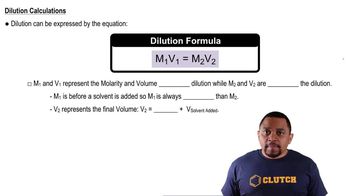
Dilution is the process of reducing the concentration of a solute in a solution, typically by adding more solvent. The relationship between the initial and final concentrations and volumes can be described by the dilution equation, C1V1 = C2V2, where C is concentration and V is volume. Understanding this concept is key to solving the problem, as it allows for the calculation of the final volume needed to achieve half the original molarity.
Video consigliato:
Percorso guidato
00:58
Dilution Equation

Stoichiometry

Stoichiometry involves the calculation of reactants and products in chemical reactions based on the conservation of mass. In the context of solutions, it helps in determining the relationships between the amounts of solute and solvent. For this question, stoichiometric principles are applied to find the volume of water needed to dilute the sucrose solution to the desired molarity, ensuring that the calculations adhere to the principles of conservation.
Video consigliato:
Percorso guidato
01:16
Stoichiometry Concept