
We have learned in this chapter that many ionic solids dissolve in water as strong electrolytes; that is, as separated ions in solution. Which statement is most correct about this process? (a) Water is a strong acid and therefore is good at dissolving ionic solids. (b) Water is good at solvating ions because the hydrogen and oxygen atoms in water molecules bear partial charges. (c) The hydrogen and oxygen bonds of water are easily broken by ionic solids.
Ch.4 - Reactions in Aqueous Solution
Brown14th EditionChemistry: The Central ScienceISBN: 9780134414232Non è quello che usi tu?Cambia libro di testo
Capitolo 4, Problema 16
Would you expect that an anion would be physically closer to the oxygen or to the hydrogens of water molecules that surround it in solution?
Guida verificata passo dopo passo1
Identify the structure of a water molecule, which consists of one oxygen atom and two hydrogen atoms.
Understand that water is a polar molecule, with a partial negative charge on the oxygen atom and a partial positive charge on the hydrogen atoms.
Recognize that anions are negatively charged ions.
Consider the concept of electrostatic attraction, where opposite charges attract each other.
Conclude that the anion would be physically closer to the hydrogen atoms of the water molecules due to the attraction between the negatively charged anion and the positively charged hydrogen atoms.

Risposta video verificata per un problema simile:
Questa soluzione video è stata consigliata dai nostri tutor come utile per risolvere questo problema.
Durata del video:
1mConcetti chiave
Ecco i concetti essenziali che devi comprendere per rispondere correttamente alla domanda.
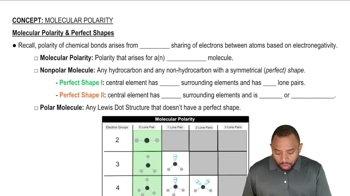
Polarity of Water
Water is a polar molecule, meaning it has a partial positive charge on the hydrogen atoms and a partial negative charge on the oxygen atom. This polarity allows water molecules to interact differently with ions in solution, with the negative end (oxygen) being attracted to positively charged cations and the positive ends (hydrogens) being attracted to negatively charged anions.
Video consigliato:
Percorso guidato
Molecular Polarity
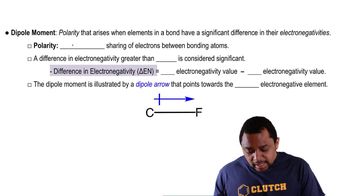
Ion-Dipole Interactions
Ion-dipole interactions occur when an ion interacts with the polar molecules of a solvent, such as water. Anions, which carry a negative charge, are attracted to the positive ends of water molecules (the hydrogen atoms), leading to a closer proximity to the hydrogens than to the oxygen atoms in the surrounding water.
Video consigliato:
Percorso guidato
Dipole Moment
Hydration Shell
When an ion is dissolved in water, it becomes surrounded by a layer of water molecules known as a hydration shell. For anions, this shell is formed primarily by water molecules orienting themselves with their hydrogen atoms facing the anion, which stabilizes the ion in solution and affects its behavior and interactions with other species.
Video consigliato:
Percorso guidato
Ionic Hydrates Naming
Pratica correlata
Domanda del libro di testo
950
views
Domanda del libro di testo
Ignoring protolysis reactions (i.e. proton transfer reaction), specify what ions are present in a solution upon dissolving each of the following substances in water: (b)(NH4)3PO4 (c) Na2Cr2O7 (d) NaPF6.
565
views
Domanda del libro di testo
Choose the best answer: A colloidal dispersion of one liquid
in another is called (a) a gel, (b) an emulsion, (c) a foam,
(d) an aerosol
133
views
Domanda del libro di testo
Specify what ions are present upon dissolving each of the following substances in water: (a) MgI2
462
views
Domanda del libro di testo
Ignoring protolysis reactions (i.e. proton transfer reaction), specify what ions are present in a solution upon dissolving each of the following substances in water: (a)Li2CO3
376
views
