
Ch.4 - Reactions in Aqueous Solution
Brown - Chemistry: The Central Science 14th Edition
Brown14th EditionChemistry: The Central ScienceISBN: 9780134414232Non è quello che usi tu?Cambia libro di testo
Capitolo 4, Problema 53

Write balanced molecular and net ionic equations for the reactions of (a) manganese with dilute sulfuric acid (b) chromium with hydrobromic acid (c) tin with hydrochloric acid (d) aluminum with formic acid, HCOOH.

Guida verificata passo dopo passo
1
Identify the reactants: Aluminum (Al) and formic acid (HCOOH).
Write the unbalanced molecular equation: Al + HCOOH → Al(HCOO)₃ + H₂.
Balance the molecular equation by ensuring the number of atoms of each element is the same on both sides.
Write the complete ionic equation by dissociating all strong electrolytes into their ions.
Identify and cancel out the spectator ions to write the net ionic equation, focusing on the species that undergo a change.

Risposta video verificata per un problema simile:

Questa soluzione video è stata consigliata dai nostri tutor come utile per risolvere questo problema.
Durata del video:
3m

Concetti chiave

Ecco i concetti essenziali che devi comprendere per rispondere correttamente alla domanda.

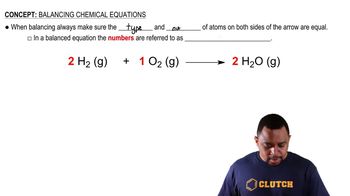
Balancing Chemical Equations

Balancing chemical equations involves ensuring that the number of atoms of each element is the same on both the reactant and product sides. This is based on the law of conservation of mass, which states that matter cannot be created or destroyed in a chemical reaction. A balanced equation provides a clear representation of the reactants and products involved in a reaction.
Video consigliato:
Percorso guidato
01:32
Balancing Chemical Equations

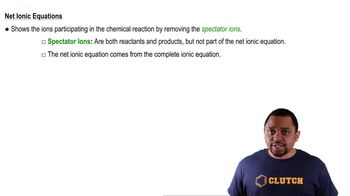
Molecular and Net Ionic Equations

A molecular equation shows the complete chemical formulas of reactants and products, while a net ionic equation focuses on the species that actually participate in the reaction. To derive the net ionic equation, spectator ions—those that do not change during the reaction—are removed from the molecular equation. This distinction is crucial for understanding the underlying chemistry in reactions, especially in aqueous solutions.
Video consigliato:
Percorso guidato
00:51
Net Ionic Equations

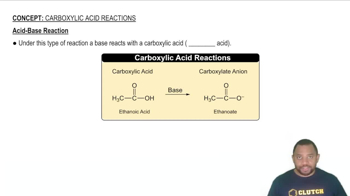
Acid-Base Reactions

Acid-base reactions involve the transfer of protons (H⁺ ions) between reactants. In the case of formic acid (HCOOH), a weak acid, it can donate a proton to a metal like aluminum, which can undergo oxidation. Understanding the behavior of acids and bases, including their strength and the resulting products, is essential for predicting the outcomes of such reactions.
Video consigliato:
Percorso guidato
01:09
Acid-Base Reaction