
Which of the following are redox reactions? For those that are, indicate which element is oxidized and which is reduced. For those that are not, indicate whether they are precipitation or neutralization reactions. (a) P4(s) + 10 HClO(aq) + 6 H2O(l) → 4 H3PO4(aq) + 10 HCl(aq) (b) Br2(l) + 2 K(s)→ 2 KBr(s) (c) CH3CH2OH(l) + 3 O2(g) → 3 H2O(l) + 2 CO2(g) (d) ZnCl2(aq) + 2 NaOH(aq) → Zn(OH)2(s) + 2 NaCl(aq)
Ch.4 - Reactions in Aqueous Solution
Brown14th EditionChemistry: The Central ScienceISBN: 9780134414232Non è quello che usi tu?Cambia libro di testo
Capitolo 4, Problema 51b
Which element is oxidized, and which is reduced in the following reactions? (b) 3 Fe(NO3)2(aq) + 2 Al(s) → 3 Fe(s) + 2 Al(NO3)3(aq)
Guida verificata passo dopo passo1
Identify the oxidation states of each element in the reactants and products. For the reactants: In Fe(NO3)2, iron (Fe) typically has an oxidation state of +2 and each nitrate (NO3) group has an oxidation state of -1. Aluminum (Al) is in its elemental form, so its oxidation state is 0. For the products: In Fe, iron is in its elemental form, so its oxidation state is 0. In Al(NO3)3, aluminum has an oxidation state of +3 and each nitrate group still has an oxidation state of -1.
Compare the oxidation states of each element in the reactants and products to determine the changes. Iron (Fe) changes from +2 in Fe(NO3)2 to 0 in Fe, indicating a decrease in oxidation state, which is a gain of electrons (reduction). Aluminum (Al) changes from 0 in its elemental form to +3 in Al(NO3)3, indicating an increase in oxidation state, which is a loss of electrons (oxidation).
Conclude which element is oxidized and which is reduced based on the changes in oxidation states. Aluminum (Al) is oxidized as it loses electrons (increase in oxidation state from 0 to +3). Iron (Fe) is reduced as it gains electrons (decrease in oxidation state from +2 to 0).
Write the half-reactions for each process to further illustrate the changes. Oxidation half-reaction: Al(s) → Al^3+(aq) + 3e^-. Reduction half-reaction: Fe^2+(aq) + 2e^- → Fe(s).
Combine the half-reactions to check if the overall electron transfer is balanced, ensuring the number of electrons lost in oxidation equals the number of electrons gained in reduction.

Risposta video verificata per un problema simile:
Questa soluzione video è stata consigliata dai nostri tutor come utile per risolvere questo problema.
Durata del video:
1mConcetti chiave
Ecco i concetti essenziali che devi comprendere per rispondere correttamente alla domanda.
Oxidation and Reduction
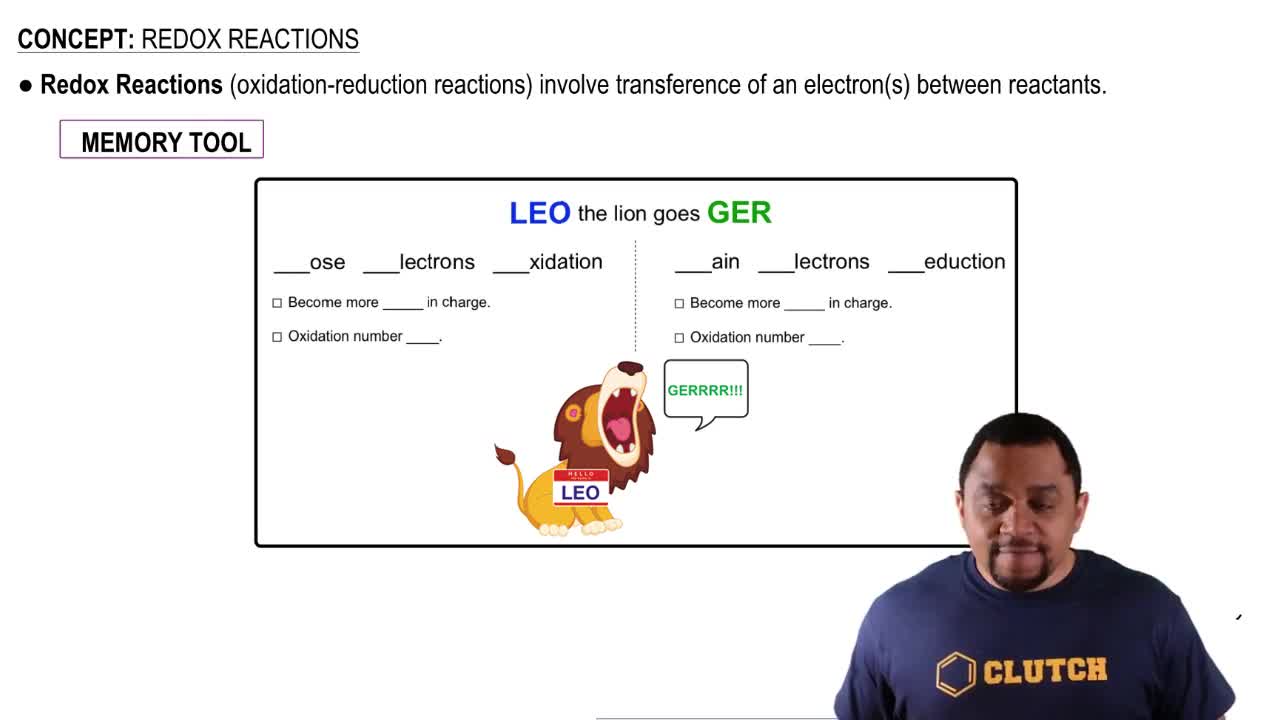
Oxidation and reduction are chemical processes that involve the transfer of electrons between substances. Oxidation refers to the loss of electrons, resulting in an increase in oxidation state, while reduction involves the gain of electrons, leading to a decrease in oxidation state. These processes always occur simultaneously in a redox reaction.
Video consigliato:
Percorso guidato
Oxidation and Reduction Reactions
Oxidation States
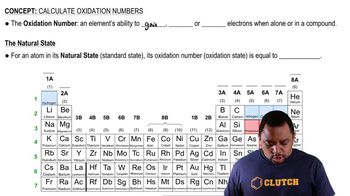
Oxidation states (or oxidation numbers) are assigned to atoms in a compound to indicate their degree of oxidation or reduction. They help in identifying which elements are oxidized and reduced in a reaction. For example, in the reaction provided, determining the oxidation states of iron (Fe) and aluminum (Al) will clarify which element undergoes oxidation and which undergoes reduction.
Video consigliato:
Percorso guidato
Oxidation Numbers
Half-Reactions
Half-reactions are a way to separate the oxidation and reduction processes in a redox reaction. Each half-reaction shows either the loss of electrons (oxidation) or the gain of electrons (reduction) for a specific species. By writing the half-reactions for the given reaction, one can easily identify the oxidized and reduced elements, facilitating a clearer understanding of the overall reaction.
Video consigliato:
Percorso guidato
First-Order Half-Life
Pratica correlata
Domanda del libro di testo
657
views
Domanda del libro di testo
Determine the oxidation number for the indicated element in each of the following substances: (e) Pt in PtCl4 (f) O in OF2.
519
views
Domanda del libro di testo
Which element is oxidized, and which is reduced in the following reactions? (a) N2(g) + 3 H2(g) → 2 NH3(g)
458
views
Domanda del libro di testo
Which element is oxidized, and which is reduced in the following reactions? (c) Cl2(aq) + 2 NaI(aq) → I2(aq) + 2 NaCl(aq) (d) PbS(s) + 4 H2O2(aq) → PbSO4(s) + 4 H2O(l)
718
views
Domanda del libro di testo
Write balanced molecular and net ionic equations for the reactions of (a) manganese with dilute sulfuric acid (b) chromium with hydrobromic acid (c) tin with hydrochloric acid (d) aluminum with formic acid, HCOOH.
751
views
Domanda del libro di testo
Determine the oxidation number for the indicated element in each of the following substances: (f) Cl in NaClO4.
389
views
