
Ch.5 - Thermochemistry
Brown - Chemistry: The Central Science 14th Edition
Brown14th EditionChemistry: The Central ScienceISBN: 9780134414232Non è quello che usi tu?Cambia libro di testo
Capitolo 5, Problema 70a

Write balanced equations that describe the formation of the following compounds from elements in their standard states, and then look up the standard enthalpy of formation for each substance in Appendix C: (a) CH3OH(l)

Guida verificata passo dopo passo
1
Identify the elements in their standard states that make up the compound CH3OH(l), which are carbon (C), hydrogen (H), and oxygen (O). Carbon is in the solid state as graphite, hydrogen is a gas (H2), and oxygen is also a gas (O2).
Write the unbalanced equation using these elements: C(s) + H2(g) + O2(g) → CH3OH(l).
Balance the equation by adjusting the coefficients to ensure the same number of each type of atom on both sides of the equation. The balanced equation should be: 2C(s) + 4H2(g) + O2(g) → 2CH3OH(l).
Check the balanced equation to confirm that the number of atoms for each element is equal on both sides of the equation. For example, there should be 2 carbon atoms, 8 hydrogen atoms, and 2 oxygen atoms on both sides.
Look up the standard enthalpy of formation (ΔHf°) for CH3OH(l) in Appendix C of your chemistry textbook or a reliable chemistry database.

Risposta video verificata per un problema simile:

Questa soluzione video è stata consigliata dai nostri tutor come utile per risolvere questo problema.
Durata del video:
4m

Concetti chiave

Ecco i concetti essenziali che devi comprendere per rispondere correttamente alla domanda.

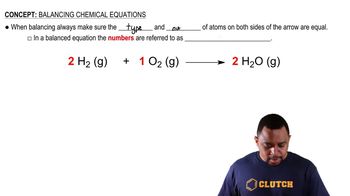
Balanced Chemical Equations

A balanced chemical equation represents a chemical reaction where the number of atoms for each element is the same on both sides of the equation. This is crucial for obeying the law of conservation of mass. To balance an equation, coefficients are adjusted to ensure that the total number of each type of atom is equal, reflecting the stoichiometry of the reaction.
Video consigliato:
Percorso guidato
01:32
Balancing Chemical Equations

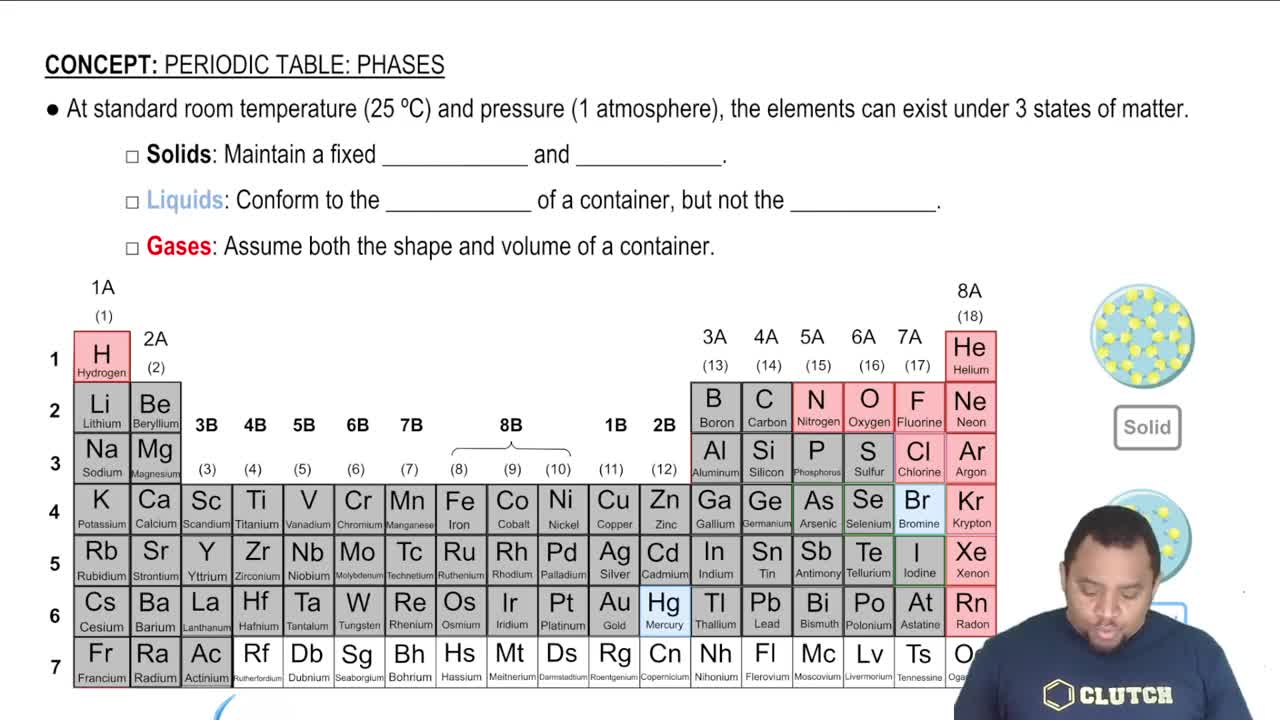
Standard State of Elements

The standard state of an element refers to its most stable form at a specified temperature (usually 25°C) and pressure (1 atm). For example, the standard state of carbon is graphite, and for oxygen, it is O2 gas. Understanding standard states is essential for accurately writing formation reactions, as they provide the baseline conditions under which enthalpy changes are measured.
Video consigliato:
Percorso guidato
03:25
Element States of Matter

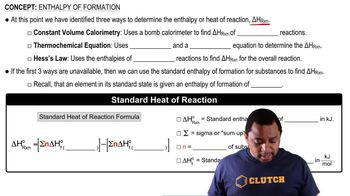
Standard Enthalpy of Formation

The standard enthalpy of formation (ΔH_f°) is the change in enthalpy when one mole of a compound is formed from its elements in their standard states. This value is crucial for thermodynamic calculations and helps predict the energy changes associated with chemical reactions. It is typically found in tables and is used to calculate the overall enthalpy change for reactions involving the formation of compounds.
Video consigliato:
Percorso guidato
02:34
Enthalpy of Formation