

Ch.5 - Thermochemistry
Brown - Chemistry: The Central Science 14th Edition
Brown14th EditionChemistry: The Central ScienceISBN: 9780134414232Non è quello che usi tu?Cambia libro di testo
Capitolo 5, Problema 67

(c) What is meant by the term standard enthalpy of formation?

Guida verificata passo dopo passo
1
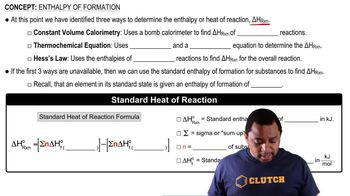
The standard enthalpy of formation, denoted as \( \Delta H_f^\circ \), is the change in enthalpy when one mole of a compound is formed from its elements in their standard states under standard conditions (1 atm pressure and 298 K temperature).
Standard states refer to the most stable form of an element at 1 atm and 298 K. For example, the standard state of oxygen is \( O_2(g) \), and for carbon, it is graphite.
The standard enthalpy of formation for any element in its standard state is defined as zero. This provides a reference point for measuring the enthalpy changes of reactions.
The standard enthalpy of formation is used to calculate the enthalpy changes of chemical reactions using Hess's Law, which states that the total enthalpy change for a reaction is the sum of the enthalpy changes for each step of the reaction.
In practice, \( \Delta H_f^\circ \) values are used in thermochemical equations to determine the heat absorbed or released during the formation of compounds from their constituent elements.

Risposta video verificata per un problema simile:

Questa soluzione video è stata consigliata dai nostri tutor come utile per risolvere questo problema.
Durata del video:
1m

Concetti chiave

Ecco i concetti essenziali che devi comprendere per rispondere correttamente alla domanda.

Standard Enthalpy of Formation

The standard enthalpy of formation (ΔH°f) is defined as the change in enthalpy when one mole of a compound is formed from its elements in their standard states at a specified temperature, usually 25°C. This value is crucial for understanding the energy changes associated with chemical reactions and is typically expressed in kilojoules per mole (kJ/mol).
Video consigliato:
Percorso guidato
02:34
Enthalpy of Formation

Standard State

The standard state of a substance refers to its physical state (solid, liquid, or gas) at a pressure of 1 atmosphere and a specified temperature, usually 25°C. For elements, the standard state is the most stable form of the element under these conditions. Understanding standard states is essential for accurately calculating enthalpy changes.
Video consigliato:
Percorso guidato
01:10
Standard Reduction Potentials

Enthalpy Change

Enthalpy change (ΔH) is a measure of the heat content of a system at constant pressure. It reflects the energy absorbed or released during a chemical reaction. The standard enthalpy of formation specifically quantifies the energy change when forming a compound from its elements, providing insight into the stability and reactivity of substances.
Video consigliato:
Percorso guidato
02:34
Enthalpy of Formation
Pratica correlata
Domanda del libro di testo

For each of the following compounds, write a balanced thermochemical equation depicting the formation of one mole of the compound from its elements in their standard states and then look up ΔH°f for each substance in Appendix C. (a) NO2(g) (b) SO3(g) (c) NaBr(s) (d) Pb(NO3)2(s).

1051
views
Domanda del libro di testo

Given the data N2(g) + O2(g) → 2 NO(g) ΔH = +180.7 kJ 2 NO(g) + O2(g) → 2 NO2(g) ΔH = -113.1 kJ 2 N2O(g) → 2 N2(g) + O2(g) ΔH = -163.2 kJ use Hess's law to calculate ΔH for the reaction N2O(g) + NO2(g) → 3 NO(g)

894
views
Domanda del libro di testo

(a) Why does the standard enthalpy of formation of both the very reactive fluorine (F2) and the almost inert gas nitrogen (N2) both read zero?

556
views
Domanda del libro di testo

Write balanced equations that describe the formation of the following compounds from elements in their standard states, and then look up the standard enthalpy of formation for each substance in Appendix C: (a) CH3OH(l)

1009
views
1
rank
Domanda del libro di testo

From the enthalpies of reaction H2(g) + F2(g) → 2 HF(g) ΔH = -537 kJ C(s) + 2 F2(g) → CF4(g) ΔH = -680 kJ 2 C(s) + 2 H2(g) → C2H4(g) ΔH = +52.3 kJ Calculate H for the reaction of ethylene with F2: C2H4(g) + 6 F2(g) → 2 CF4(g) + 4 HF(g)

971
views
Domanda del libro di testo

From the enthalpies of reaction 2 C(s) + O2(g) → 2 CO(g) ΔH = -221.0 kJ 2 C(s) + O2(g) + 4 H2(g) → 2 CH3OH(g) ΔH = -402.4 kJ Calculate ΔH for the reaction CO(g) + 2 H2(g) → CH3OH(g)

411
views