
Ch.5 - Thermochemistry
Brown - Chemistry: The Central Science 14th Edition
Brown14th EditionChemistry: The Central ScienceISBN: 9780134414232Non è quello che usi tu?Cambia libro di testo
Capitolo 5, Problema 57a

A 1.50-g sample of quinone (C6H4O2) is burned in a bomb calorimeter whose total heat capacity is 8.500 kJ/°C. The temperature of the calorimeter increases from 25.00 to 29.49 °C. (a) Write a balanced chemical equation for the bomb calorimeter reaction.

Guida verificata passo dopo passo
1
Identify the chemical formula of quinone, which is C_6H_4O_2.
Write the general form of a combustion reaction: C_xH_yO_z + O_2 -> CO_2 + H_2O.
Balance the carbon atoms by ensuring the number of CO_2 molecules equals the number of carbon atoms in quinone.
Balance the hydrogen atoms by ensuring the number of H_2O molecules equals half the number of hydrogen atoms in quinone.
Balance the oxygen atoms by adjusting the O_2 molecules, considering the oxygen atoms in both CO_2 and H_2O products.

Risposta video verificata per un problema simile:

Questa soluzione video è stata consigliata dai nostri tutor come utile per risolvere questo problema.
Durata del video:
2m

Concetti chiave

Ecco i concetti essenziali che devi comprendere per rispondere correttamente alla domanda.

Combustion Reactions

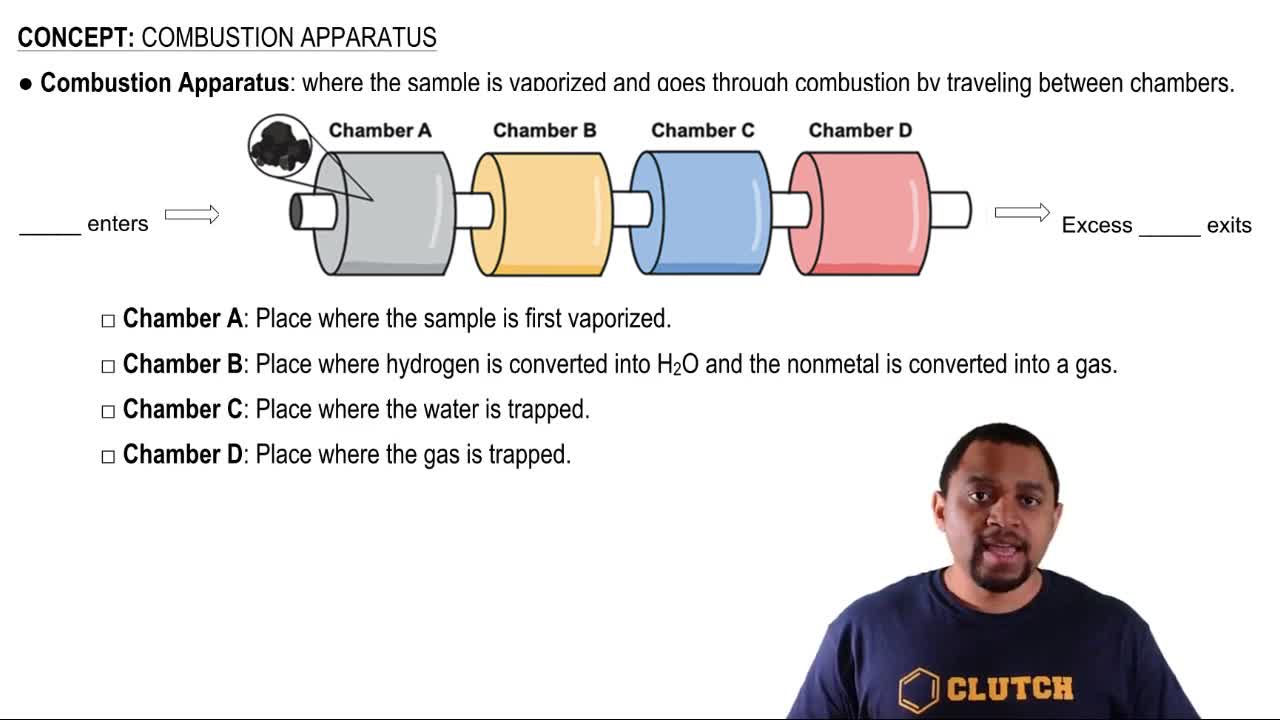
Combustion reactions involve the reaction of a substance with oxygen, producing heat and light. In the case of quinone (C6H4O2), the combustion will yield carbon dioxide (CO2) and water (H2O) as products. Understanding the stoichiometry of the reaction is essential for writing a balanced chemical equation, which reflects the conservation of mass.
Video consigliato:
Percorso guidato
02:24
Combustion Apparatus

Calorimetry

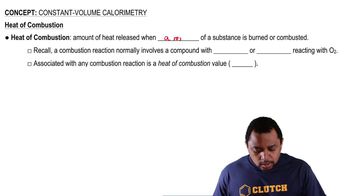
Calorimetry is the science of measuring the heat of chemical reactions or physical changes. In a bomb calorimeter, the heat released during the combustion of a sample is absorbed by the calorimeter, leading to a measurable temperature change. The heat capacity of the calorimeter allows for the calculation of the heat released by the reaction, which is crucial for understanding the energy changes involved.
Video consigliato:
Percorso guidato
00:50
Constant-Volume Calorimetry

Balanced Chemical Equations

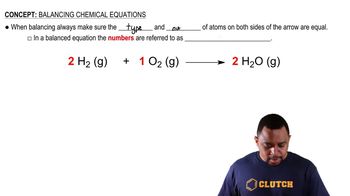
A balanced chemical equation represents a chemical reaction with equal numbers of each type of atom on both sides of the equation. This balance is achieved by adjusting coefficients in front of the reactants and products. Writing a balanced equation for the combustion of quinone is necessary to accurately depict the reactants and products involved, ensuring that the stoichiometric relationships are correctly represented.
Video consigliato:
Percorso guidato
01:32
Balancing Chemical Equations
Pratica correlata
Domanda del libro di testo

When a 6.50-g sample of solid sodium hydroxide dissolves in 100.0 g of water in a coffee-cup calorimeter (Figure 5.18), the temperature rises from 21.6 to 37.8 °C (b) Using your result from part (a), calculate H (in kJ/mol KOH) for the solution process. Assume that the specific heat of the solution is the same as that of pure water.

584
views
1
comments
Domanda del libro di testo

A 2.20-g sample of phenol (C6H5OH) was burned in a bomb calorimeter whose total heat capacity is 11.90 kJ/°C. The temperature of the calorimeter plus contents increased from 21.50 to 27.50 °C. (b) What is the heat of combustion per mole of phenol?

780
views
Domanda del libro di testo

Under constant-volume conditions, the heat of combustion of benzoic acid (C6H5O6) is 15.57 kJ/g. A 3.500-g sample of sucrose is burned in a bomb calorimeter. The temperature of the calorimeter increases from 20.94 to 24.72 °C. (a) What is the total heat capacity of the calorimeter?

1939
views
Domanda del libro di testo

(b) Is this process endothermic or exothermic?

487
views
Domanda del libro di testo

A 1.50-g sample of quinone (C6H4O2) is burned in a bomb calorimeter whose total heat capacity is 8.500 kJ/°C. The temperature of the calorimeter increases from 25.00 to 29.49°C. (b) What is the heat of combustion per gram of quinone and per mole of quinone?

1448
views
Domanda del libro di testo

A 2.20-g sample of phenol (C6H5OH) was burned in a bomb calorimeter whose total heat capacity is 11.90 kJ/°C. The temperature of the calorimeter plus contents increased from 21.50 to 27.50 °C. (a) Write a balanced chemical equation for the bomb calorimeter reaction.

704
views