
Ch.5 - Thermochemistry
Brown - Chemistry: The Central Science 14th Edition
Brown14th EditionChemistry: The Central ScienceISBN: 9780134414232Non è quello che usi tu?Cambia libro di testo
Capitolo 5, Problema 115

A 201-lb man decides to add to his exercise routine by walking up three flights of stairs (45 ft) 20 times per day. Hefigures that theworkrequired to increasehis potential energy in this way will permit him to eat an extra order of French fries, at 245 Cal, without adding to his weight. Is he correct in this assumption?

Guida verificata passo dopo passo
1
Convert the man's weight from pounds to kilograms using the conversion factor: 1 lb = 0.453592 kg.
Calculate the work done in one trip up the stairs using the formula for gravitational potential energy: \( \text{Work} = mgh \), where \( m \) is mass in kg, \( g \) is the acceleration due to gravity (9.8 m/s²), and \( h \) is the height in meters.
Convert the height from feet to meters using the conversion factor: 1 ft = 0.3048 m.
Calculate the total work done for 20 trips by multiplying the work done in one trip by 20.
Convert the total work from joules to calories using the conversion factor: 1 Cal = 4184 J, and compare it to 245 Cal to determine if the man can eat the extra order of French fries.

Risposta video verificata per un problema simile:

Questa soluzione video è stata consigliata dai nostri tutor come utile per risolvere questo problema.
Durata del video:
3m

Concetti chiave

Ecco i concetti essenziali che devi comprendere per rispondere correttamente alla domanda.

Work and Energy

In physics, work is defined as the energy transferred when a force is applied over a distance. The work done against gravity to lift an object is calculated using the formula W = mgh, where W is work, m is mass, g is the acceleration due to gravity, and h is the height. Understanding this concept is crucial for determining the energy expenditure of the man as he walks up the stairs.
Video consigliato:
Percorso guidato
01:52
Work Function Calculation Example

Potential Energy

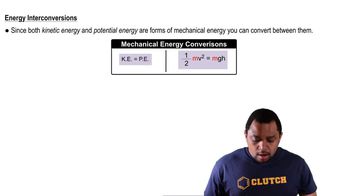
Potential energy is the energy stored in an object due to its position in a gravitational field. For an object at height h, the potential energy can be expressed as PE = mgh. In this scenario, the man increases his potential energy by ascending the stairs, which can be quantified to assess whether he can offset the caloric intake from the French fries.
Video consigliato:
Percorso guidato
00:34
Kinetic & Potential Energy

Caloric Energy and Conversion

Calories are a unit of energy commonly used to quantify the energy content of food and the energy expenditure of physical activities. One dietary Calorie (Cal) is equivalent to 1,000 calories (cal). To determine if the man can eat an extra order of French fries without gaining weight, it is essential to compare the energy expended from climbing the stairs to the caloric value of the fries.
Video consigliato:
Percorso guidato
01:56
Conversion Factors