Ch.5 - Thermochemistry
Brown - Chemistry: The Central Science 14th Edition
Brown14th EditionChemistry: The Central ScienceISBN: 9780134414232Non è quello che usi tu?Cambia libro di testo
Capitolo 5, Problema 113

When magnesium metal is burned in air (Figure 3.6), two products are produced. One is magnesium oxide, MgO. The other is the product of the reaction of Mg with molecular nitrogen, magnesium nitride. When water is added to magnesium nitride, it reacts to form magnesium oxide and ammonia gas. (e) The standard enthalpy of formation of solid magnesium nitride is -461.08 kJ>mol. Calculate the standard enthalpy change for the reaction between magnesium metal and ammonia gas.

Guida verificata passo dopo passo
1
Identify the chemical reactions involved: (1) Formation of magnesium nitride from magnesium and nitrogen, and (2) Reaction of magnesium nitride with water to form magnesium oxide and ammonia.
Write the balanced chemical equations for these reactions: (1) \( 3 \text{Mg} + \text{N}_2 \rightarrow \text{Mg}_3\text{N}_2 \) and (2) \( \text{Mg}_3\text{N}_2 + 6\text{H}_2\text{O} \rightarrow 3\text{MgO} + 2\text{NH}_3 \).
Use Hess's Law to find the enthalpy change for the reaction between magnesium metal and ammonia gas. This involves combining the enthalpy changes of the two reactions.
Calculate the enthalpy change for the formation of magnesium nitride using the given standard enthalpy of formation: \( \Delta H_f^\circ (\text{Mg}_3\text{N}_2) = -461.08 \text{ kJ/mol} \).
Determine the overall enthalpy change for the reaction between magnesium metal and ammonia gas by considering the enthalpy changes of the individual reactions and applying Hess's Law.

Risposta video verificata per un problema simile:

Questa soluzione video è stata consigliata dai nostri tutor come utile per risolvere questo problema.
Durata del video:
3m

Concetti chiave

Ecco i concetti essenziali che devi comprendere per rispondere correttamente alla domanda.

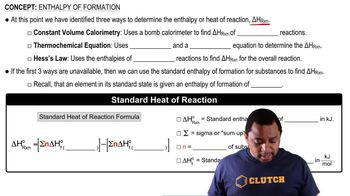
Standard Enthalpy of Formation

The standard enthalpy of formation (ΔH_f°) is the change in enthalpy when one mole of a compound is formed from its elements in their standard states. It is a crucial concept in thermodynamics, allowing chemists to calculate the energy changes associated with chemical reactions. The values are typically tabulated and can be used to determine the enthalpy change for reactions using Hess's law.
Video consigliato:
Percorso guidato
02:34
Enthalpy of Formation

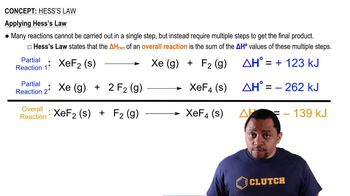
Hess's Law

Hess's Law states that the total enthalpy change for a reaction is the same, regardless of the number of steps taken to achieve the reaction. This principle allows for the calculation of enthalpy changes by summing the enthalpy changes of individual steps, making it possible to derive the enthalpy change for complex reactions from simpler ones. It is particularly useful when direct measurement of a reaction's enthalpy change is difficult.
Video consigliato:

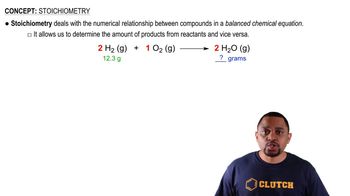
Reaction Stoichiometry

Reaction stoichiometry involves the quantitative relationships between reactants and products in a chemical reaction. Understanding stoichiometry is essential for calculating the amounts of substances consumed and produced, as well as for determining the enthalpy changes associated with these reactions. It allows chemists to balance chemical equations and apply the mole concept to predict the outcomes of reactions.
Video consigliato:
Percorso guidato
01:16
Stoichiometry Concept
Pratica correlata