Ch.5 - Thermochemistry
Brown - Chemistry: The Central Science 14th Edition
Brown14th EditionChemistry: The Central ScienceISBN: 9780134414232Non è quello che usi tu?Cambia libro di testo
Capitolo 5, Problema 23a

(a) According to the first law of thermodynamics, what quantity is conserved?

Guida verificata passo dopo passo
1
The first law of thermodynamics is a version of the law of conservation of energy, adapted for thermodynamic systems.
It states that energy cannot be created or destroyed in an isolated system.
The first law is often expressed as \( \Delta U = Q - W \), where \( \Delta U \) is the change in internal energy of the system, \( Q \) is the heat added to the system, and \( W \) is the work done by the system.
According to this law, the total energy of an isolated system is constant.
Therefore, the quantity that is conserved according to the first law of thermodynamics is energy.

Risposta video verificata per un problema simile:

Questa soluzione video è stata consigliata dai nostri tutor come utile per risolvere questo problema.
Durata del video:
1m

Concetti chiave

Ecco i concetti essenziali che devi comprendere per rispondere correttamente alla domanda.

First Law of Thermodynamics

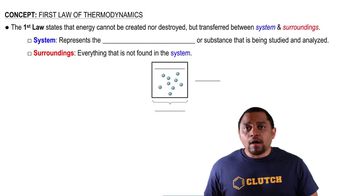
The First Law of Thermodynamics, also known as the law of energy conservation, states that energy cannot be created or destroyed in an isolated system. Instead, energy can only be transformed from one form to another. This principle is fundamental in understanding how energy flows in physical and chemical processes.
Video consigliato:
Percorso guidato
01:18
First Law of Thermodynamics

Internal Energy

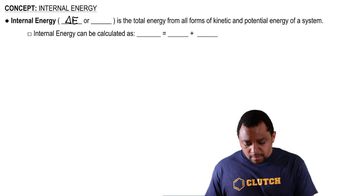
Internal energy is the total energy contained within a system, including kinetic and potential energy at the molecular level. According to the First Law of Thermodynamics, any change in the internal energy of a system is equal to the heat added to the system minus the work done by the system on its surroundings. This concept is crucial for analyzing thermodynamic processes.
Video consigliato:
Percorso guidato
00:40
Internal Energy

Work and Heat

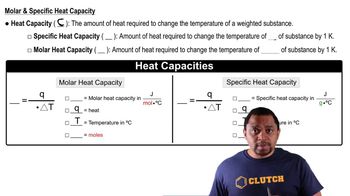
In thermodynamics, work and heat are two ways energy can be transferred between a system and its surroundings. Work refers to energy transfer that occurs when a force is applied over a distance, while heat is the energy transferred due to a temperature difference. Understanding these concepts is essential for applying the First Law of Thermodynamics to real-world scenarios.
Video consigliato: