Ch.5 - Thermochemistry
Brown - Chemistry: The Central Science 14th Edition
Brown14th EditionChemistry: The Central ScienceISBN: 9780134414232Non è quello che usi tu?Cambia libro di testo
Capitolo 5, Problema 23b

(b) What is meant by the internal energy of a system?

Guida verificata passo dopo passo
1
The internal energy of a system, often denoted as 'U', is the total energy contained within the system. It includes all forms of energy such as kinetic energy due to the motion of particles and potential energy due to the interactions between particles.
Internal energy is a state function, meaning it depends only on the current state of the system and not on how the system reached that state. This implies that changes in internal energy are independent of the path taken.
In thermodynamics, the change in internal energy (ΔU) of a system can be expressed using the first law of thermodynamics: ΔU = Q - W, where Q is the heat added to the system and W is the work done by the system.
The internal energy can be influenced by changes in temperature, volume, and pressure, as these factors affect the kinetic and potential energies of the particles within the system.
Understanding internal energy is crucial for analyzing energy changes in chemical reactions and physical processes, as it helps in determining how energy is transferred and transformed within a system.

Risposta video verificata per un problema simile:

Questa soluzione video è stata consigliata dai nostri tutor come utile per risolvere questo problema.
Durata del video:
51s

Concetti chiave

Ecco i concetti essenziali che devi comprendere per rispondere correttamente alla domanda.

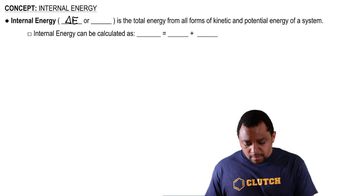
Internal Energy

Internal energy is the total energy contained within a thermodynamic system, encompassing both kinetic and potential energy at the molecular level. It reflects the energy associated with the motion of particles and the interactions between them. Changes in internal energy can occur due to heat transfer or work done on or by the system.
Video consigliato:
Percorso guidato
00:40
Internal Energy

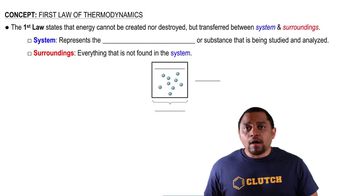
First Law of Thermodynamics

The First Law of Thermodynamics states that energy cannot be created or destroyed, only transformed from one form to another. This principle implies that the change in internal energy of a system is equal to the heat added to the system minus the work done by the system. It establishes a fundamental relationship between internal energy, heat, and work.
Video consigliato:
Percorso guidato
01:18
First Law of Thermodynamics

State Functions

State functions are properties of a system that depend only on its current state, not on the path taken to reach that state. Internal energy is a state function, meaning its value is determined solely by the current conditions of the system, such as temperature and pressure. This characteristic allows for easier calculations and predictions in thermodynamics.
Video consigliato:
Percorso guidato
03:37
Logarithmic Functions