
Ch.5 - Thermochemistry
Brown - Chemistry: The Central Science 14th Edition
Brown14th EditionChemistry: The Central ScienceISBN: 9780134414232Non è quello che usi tu?Cambia libro di testo
Capitolo 5, Problema 17

A sodium ion, Na+, with a charge of 1.6⨉10-19 C and a chloride ion, Cl - , with charge of -1.6⨉10-19 C, are separated by a distance of 0.50 nm. How much work would be required to increase the separation of the two ions to an infinite distance?

Guida verificata passo dopo passo
1
Identify the initial and final states of the system. Initially, the sodium ion (Na^+) and the chloride ion (Cl^-) are separated by a distance of 0.50 nm. The final state is when the ions are separated by an infinite distance.
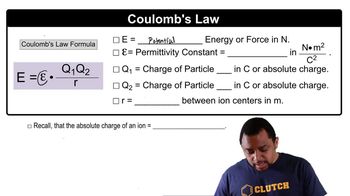
Use the formula for the electrostatic potential energy between two point charges: U = k * (q1 * q2) / r, where k is Coulomb's constant (8.99 x 10^9 N m^2/C^2), q1 and q2 are the charges of the ions, and r is the separation distance.
Calculate the initial potential energy (U_initial) using the given charges (q1 = 1.6 x 10^-19 C, q2 = -1.6 x 10^-19 C) and the initial separation distance (r = 0.50 nm = 0.50 x 10^-9 m).
Determine the final potential energy (U_final) when the ions are separated by an infinite distance. At infinite separation, the potential energy is zero because the interaction between the charges is negligible.
Calculate the work done (W) to separate the ions to an infinite distance using the formula: W = U_final - U_initial. Since U_final is zero, W = -U_initial.

Risposta video verificata per un problema simile:

Questa soluzione video è stata consigliata dai nostri tutor come utile per risolvere questo problema.
Durata del video:
5m

Concetti chiave

Ecco i concetti essenziali che devi comprendere per rispondere correttamente alla domanda.

Coulomb's Law

Coulomb's Law describes the electrostatic force between two charged particles. It states that the force is directly proportional to the product of the magnitudes of the charges and inversely proportional to the square of the distance between them. This principle is essential for calculating the work done in moving charged particles, as it provides the foundational relationship between charge, distance, and force.
Video consigliato:
Percorso guidato
01:15
Coulomb's Law Concept 2

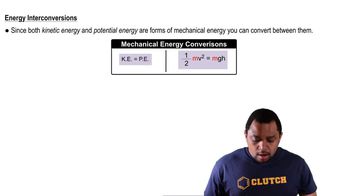
Electric Potential Energy

Electric potential energy is the energy stored in a system of charged particles due to their positions relative to each other. It can be calculated using the formula U = k * (q1 * q2) / r, where U is the potential energy, k is Coulomb's constant, q1 and q2 are the charges, and r is the distance between them. Understanding this concept is crucial for determining the work required to change the separation of charged ions.
Video consigliato:
Percorso guidato
00:34
Kinetic & Potential Energy

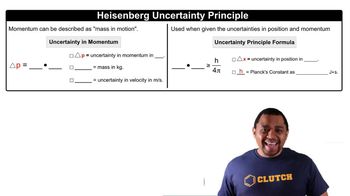
Work-Energy Principle

The work-energy principle states that the work done on an object is equal to the change in its energy. In the context of charged particles, the work required to move them from one position to another can be calculated by finding the difference in electric potential energy at those positions. This principle allows us to quantify the energy needed to separate the sodium and chloride ions to an infinite distance.
Video consigliato:
Percorso guidato
02:05
Uncertainty Principle Formula