
Ch.5 - Thermochemistry
Brown - Chemistry: The Central Science 14th Edition
Brown14th EditionChemistry: The Central ScienceISBN: 9780134414232Non è quello che usi tu?Cambia libro di testo
Capitolo 5, Problema 15a

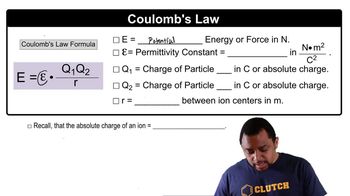
(a) The electrostatic force (not energy) of attraction between two oppositely charged objects is given by the equation F = k (Q1Q2/d2) where k = 8.99⨉109N-m2/C2, Q1 and Q2 are the charges of the two objects in Coulombs, and d is the distance separating the two objects in meters. What is the electrostatic force of attraction (in Newtons) between an electron and a proton that are separated by 1⨉102 pm?

Guida verificata passo dopo passo
1
Convert the distance from picometers to meters. Since 1 pm = 1⨉10^{-12} m, multiply 1⨉10^{2} pm by 1⨉10^{-12} m/pm to get the distance in meters.
Identify the charges of the electron and proton. The charge of an electron (Q_1) is -1.6⨉10^{-19} C, and the charge of a proton (Q_2) is +1.6⨉10^{-19} C.
Substitute the values of Q_1, Q_2, and the converted distance (d) into the formula F = k (Q_1Q_2/d^2).
Use the given value of k = 8.99⨉10^{9} N-m^2/C^2 in the formula.
Calculate the electrostatic force F by performing the multiplication and division as per the formula.

Risposta video verificata per un problema simile:

Questa soluzione video è stata consigliata dai nostri tutor come utile per risolvere questo problema.
Durata del video:
3m

Concetti chiave

Ecco i concetti essenziali che devi comprendere per rispondere correttamente alla domanda.

Coulomb's Law

Coulomb's Law describes the electrostatic force between two charged objects. It states that the force (F) is directly proportional to the product of the magnitudes of the charges (Q1 and Q2) and inversely proportional to the square of the distance (d) between them. The equation F = k(Q1Q2/d²) quantifies this relationship, where k is the electrostatic constant.
Video consigliato:
Percorso guidato
01:15
Coulomb's Law Concept 2

Units of Charge and Distance

In the context of electrostatics, charge is measured in Coulombs (C), while distance is typically measured in meters (m). The problem involves converting picometers (pm) to meters, as 1 pm equals 1×10⁻¹² m. Understanding these units is crucial for correctly applying Coulomb's Law and calculating the electrostatic force.
Video consigliato:

Electrostatic Force Calculation

To calculate the electrostatic force between an electron and a proton, one must substitute the known values into Coulomb's Law. The charge of an electron is approximately -1.6×10⁻¹⁹ C, and that of a proton is +1.6×10⁻¹⁹ C. By using the distance of 1×10² pm (or 1×10⁻¹⁰ m), one can compute the force in Newtons, which indicates the strength of the attraction between these two fundamental particles.
Video consigliato:
Percorso guidato
01:59
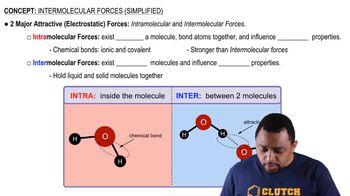
Intermolecular vs Intramolecular Forces