Ch.5 - Thermochemistry
Brown - Chemistry: The Central Science 14th Edition
Brown14th EditionChemistry: The Central ScienceISBN: 9780134414232Non è quello che usi tu?Cambia libro di testo
Capitolo 5, Problema 14a

(a) What is the electrostatic potential energy (in joules) between two electrons that are separated by 62 pm?

Guida verificata passo dopo passo
1
Identify the formula for electrostatic potential energy between two point charges, which is given by Coulomb's Law: \( U = \frac{k \cdot q_1 \cdot q_2}{r} \), where \( U \) is the potential energy, \( k \) is Coulomb's constant (\( 8.99 \times 10^9 \, \text{N m}^2/\text{C}^2 \)), \( q_1 \) and \( q_2 \) are the charges, and \( r \) is the separation between the charges.
Convert the distance from picometers to meters. Since 1 pm = \( 1 \times 10^{-12} \) meters, multiply 62 pm by \( 1 \times 10^{-12} \) to convert it to meters.
Substitute the values of the charges of the electrons, which are both \( -1.602 \times 10^{-19} \) Coulombs, into the formula.
Plug in the value of \( r \) (the converted distance in meters) and the Coulomb's constant into the formula.
Calculate the electrostatic potential energy using the values substituted into the formula. Remember that the result will be negative, indicating that the potential energy is attractive.

Risposta video verificata per un problema simile:

Questa soluzione video è stata consigliata dai nostri tutor come utile per risolvere questo problema.
Durata del video:
3m

Concetti chiave

Ecco i concetti essenziali che devi comprendere per rispondere correttamente alla domanda.

Electrostatic Potential Energy

Electrostatic potential energy is the energy stored due to the position of charged particles relative to each other. It is calculated using the formula U = k * (q1 * q2) / r, where U is the potential energy, k is Coulomb's constant, q1 and q2 are the charges, and r is the distance between them. For electrons, which have the same charge, this energy will be negative, indicating a repulsive interaction.
Video consigliato:
Percorso guidato
00:34
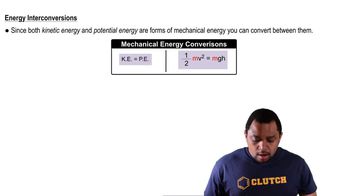
Kinetic & Potential Energy

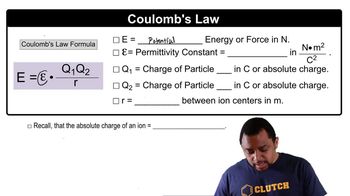
Coulomb's Law

Coulomb's Law describes the force between two charged objects and is fundamental in calculating electrostatic interactions. It states that the force (F) between two charges is directly proportional to the product of the magnitudes of the charges and inversely proportional to the square of the distance between them. This law is essential for determining the potential energy in systems involving charged particles.
Video consigliato:
Percorso guidato
01:15
Coulomb's Law Concept 2

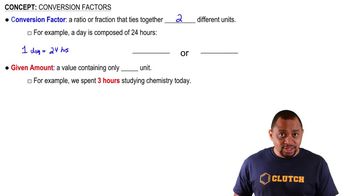
Unit Conversion

In chemistry and physics, unit conversion is crucial for ensuring that measurements are in compatible units. In this context, the distance between the electrons is given in picometers (pm), which must be converted to meters (m) for calculations involving electrostatic potential energy. Understanding how to convert units accurately is vital for obtaining correct results in scientific calculations.
Video consigliato:
Percorso guidato
01:56
Conversion Factors