
Ch.5 - Thermochemistry
Brown - Chemistry: The Central Science 14th Edition
Brown14th EditionChemistry: The Central ScienceISBN: 9780134414232Non è quello che usi tu?Cambia libro di testo
Capitolo 5, Problema 11d

Consider the two diagrams that follow. (d) Would similar relationships hold for the work involved in each process?

Guida verificata passo dopo passo
1
Identify the type of processes shown in the diagrams, such as isothermal, isobaric, isochoric, or adiabatic.
Understand the concept of work in thermodynamics, which is defined as the area under the pressure-volume (P-V) curve for the process.
Analyze the P-V diagrams provided to determine the nature of the work done in each process. For example, if the volume changes under constant pressure, the work done can be calculated using the formula W = PΔV.
Compare the initial and final states in each diagram to assess whether the work done in each process is positive, negative, or zero. Positive work is done by the system when it expands, and negative work is done on the system when it compresses.
Evaluate whether the relationships between pressure, volume, and work are similar or different in the two processes based on the changes observed in the diagrams.

Risposta video verificata per un problema simile:

Questa soluzione video è stata consigliata dai nostri tutor come utile per risolvere questo problema.
Durata del video:
3m

Concetti chiave

Ecco i concetti essenziali che devi comprendere per rispondere correttamente alla domanda.

Work in Thermodynamics

In thermodynamics, work is defined as the energy transferred when a force is applied over a distance. It is a crucial concept in understanding energy changes in physical and chemical processes. The work done can be positive or negative depending on whether the system is gaining or losing energy, which is essential for analyzing processes like expansion or compression.
Video consigliato:
Percorso guidato
01:18
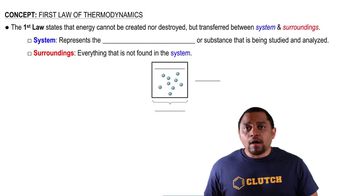
First Law of Thermodynamics

Types of Thermodynamic Processes

Thermodynamic processes can be classified into several types, including isothermal, adiabatic, isobaric, and isochoric. Each type describes how a system exchanges heat and work with its surroundings. Understanding these processes helps in predicting how energy is transferred and transformed, which is vital for answering questions about work in different scenarios.
Video consigliato:
Percorso guidato
01:18
First Law of Thermodynamics

Conservation of Energy

The principle of conservation of energy states that energy cannot be created or destroyed, only transformed from one form to another. In the context of thermodynamics, this principle implies that the total energy of a closed system remains constant. This concept is fundamental when analyzing work done in processes, as it helps to relate heat, work, and internal energy changes.
Video consigliato:
Percorso guidato
01:48
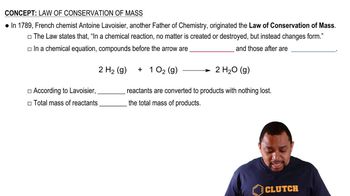
Law of Conservation of Mass