Ch.5 - Thermochemistry
Brown - Chemistry: The Central Science 14th Edition
Brown14th EditionChemistry: The Central ScienceISBN: 9780134414232Non è quello che usi tu?Cambia libro di testo
Capitolo 5, Problema 25a

Calculate ΔE and determine whether the process is endothermic or exothermic for the following cases: (a) q = 0.763 kJ and w = -840 J.

Guida verificata passo dopo passo
1
Convert the work (w) from joules to kilojoules to match the units of heat (q). Since 1 kJ = 1000 J, divide the work value by 1000: \( w = \frac{-840 \text{ J}}{1000} \text{ kJ} \).
Use the first law of thermodynamics, which states that the change in internal energy (\( \Delta E \)) is the sum of heat (q) and work (w): \( \Delta E = q + w \).
Substitute the given values into the equation: \( \Delta E = 0.763 \text{ kJ} + w \text{ (in kJ)} \).
Determine the sign of \( \Delta E \). If \( \Delta E \) is positive, the process is endothermic (absorbs energy). If \( \Delta E \) is negative, the process is exothermic (releases energy).
Interpret the result to conclude whether the process is endothermic or exothermic based on the sign of \( \Delta E \).

Risposta video verificata per un problema simile:

Questa soluzione video è stata consigliata dai nostri tutor come utile per risolvere questo problema.
Durata del video:
1m

Concetti chiave

Ecco i concetti essenziali che devi comprendere per rispondere correttamente alla domanda.

First Law of Thermodynamics

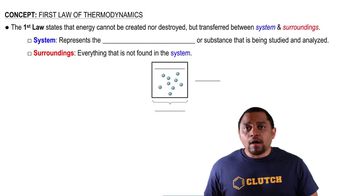
The First Law of Thermodynamics states that energy cannot be created or destroyed, only transformed from one form to another. In a closed system, the change in internal energy (ΔE) is equal to the heat added to the system (q) minus the work done by the system (w). This principle is fundamental for understanding energy transfers in chemical processes.
Video consigliato:
Percorso guidato
01:18
First Law of Thermodynamics

Internal Energy Change (ΔE)

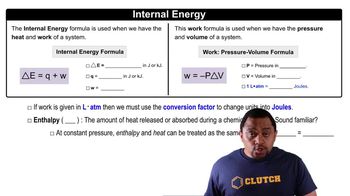
The change in internal energy (ΔE) of a system is calculated using the equation ΔE = q + w, where q represents heat transfer and w represents work done. A positive ΔE indicates that the system has gained energy, while a negative ΔE indicates a loss of energy. This concept is crucial for determining the nature of the process as either endothermic or exothermic.
Video consigliato:
Percorso guidato
01:51
Internal Energy

Endothermic vs. Exothermic Processes

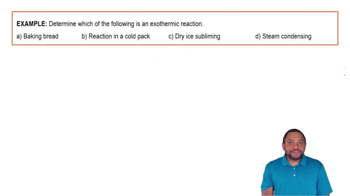
Endothermic processes absorb heat from the surroundings, resulting in a positive q value, while exothermic processes release heat, leading to a negative q value. The sign of ΔE helps classify the process: if ΔE is positive, the process is endothermic; if negative, it is exothermic. Understanding these distinctions is essential for predicting the thermal behavior of chemical reactions.
Video consigliato:
Percorso guidato
1:48
Endothermic & Exothermic Reactions Example 2