Ethanol (C2H5OH) is blended with gasoline as an automobile fuel. (d) Calculate the mass of CO2 produced per kJ of heat emitted.
Ch.5 - Thermochemistry
Brown14th EditionChemistry: The Central ScienceISBN: 9780134414232Non è quello che usi tu?Cambia libro di testo
Capitolo 5, Problema 80b
Methanol (CH3OH) is used as a fuel in race cars. (b) Calculate the standard enthalpy change for the reaction, assuming H2O(g) as a product.
Guida verificata passo dopo passo1
Determine the balanced chemical equation for the combustion of methanol (CH_3OH). The general form is: CH_3OH(l) + O_2(g) -> CO_2(g) + H_2O(g).
Balance the equation by ensuring the number of atoms of each element is the same on both sides. For methanol combustion, it becomes: 2 CH_3OH(l) + 3 O_2(g) -> 2 CO_2(g) + 4 H_2O(g).
Use standard enthalpy of formation values (ΔH_f^°) for each compound involved in the reaction. These values are typically found in a table of thermodynamic data.
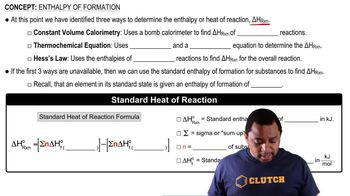
Apply Hess's Law to calculate the standard enthalpy change (ΔH_rxn^°) for the reaction: ΔH_rxn^° = [Σ ΔH_f^°(products)] - [Σ ΔH_f^°(reactants)].
Substitute the ΔH_f^° values into the equation and perform the arithmetic to find the standard enthalpy change for the reaction.

Risposta video verificata per un problema simile:
Questa soluzione video è stata consigliata dai nostri tutor come utile per risolvere questo problema.
Durata del video:
5mConcetti chiave
Ecco i concetti essenziali che devi comprendere per rispondere correttamente alla domanda.
Standard Enthalpy Change
Standard enthalpy change (ΔH°) refers to the heat change that occurs at constant pressure when one mole of a substance is formed from its elements in their standard states. It is a crucial concept in thermodynamics, allowing chemists to predict the energy changes associated with chemical reactions. This value is typically measured in kilojoules per mole (kJ/mol) and is essential for calculating the energy released or absorbed during a reaction.
Video consigliato:
Percorso guidato
Enthalpy of Formation
Combustion Reactions
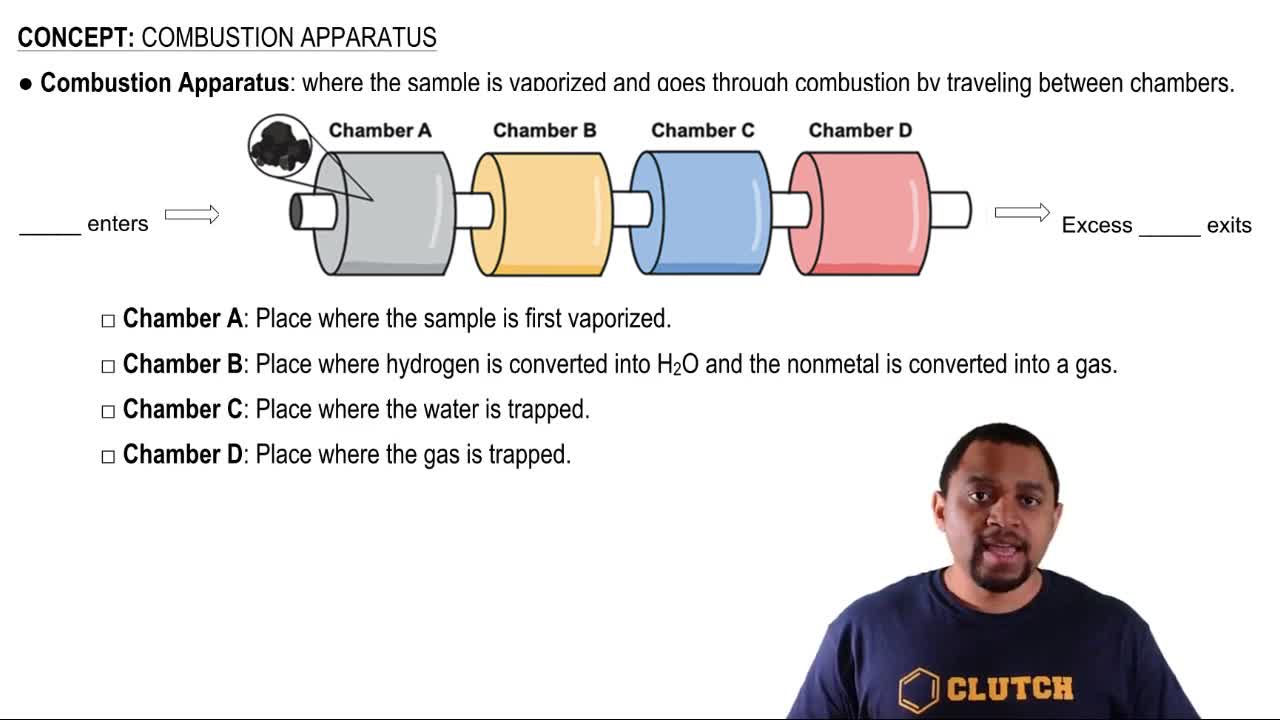
Combustion reactions involve the reaction of a substance with oxygen, producing heat and light. In the case of methanol (CH₃OH), its combustion with oxygen yields carbon dioxide (CO₂) and water (H₂O) as products. Understanding the stoichiometry of combustion reactions is vital for calculating the enthalpy change, as it allows for the determination of the amount of reactants and products involved in the reaction.
Video consigliato:
Percorso guidato
Combustion Apparatus
Hess's Law
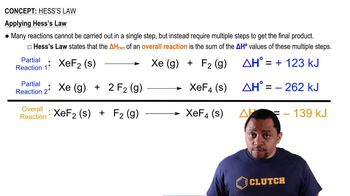
Hess's Law states that the total enthalpy change for a reaction is the sum of the enthalpy changes for the individual steps of the reaction, regardless of the pathway taken. This principle is useful for calculating the standard enthalpy change of a reaction when direct measurement is difficult. By using known enthalpy values of related reactions, one can derive the enthalpy change for the desired reaction, such as the combustion of methanol.
Video consigliato:
Percorso guidato
Hess's Law
Pratica correlata
Domanda del libro di testo
740
views
Domanda del libro di testo
Methanol (CH3OH) is used as a fuel in race cars. (c) Calculate the heat produced by combustion per liter of methanol. Methanol has a density of 0.791 g/mL.
905
views
Domanda del libro di testo
Ethanol (C2H5OH) is blended with gasoline as an automobile fuel. (b) Calculate the standard enthalpy change for the reaction, assuming H2O(g) as a product.
Domanda del libro di testo
Ethanol (C2H5OH) is blended with gasoline as an automobile fuel. (c) Calculate the heat produced per liter of ethanol by combustion of ethanol under constant pressure. Ethanol has a density of 0.789 g/mL.
917
views
Domanda del libro di testo
Methanol (CH3OH) is used as a fuel in race cars. (d) Calculate the mass of CO2 produced per kJ of heat emitted.
461
views
Domanda del libro di testo
Without doing any calculations, predict the sign of H for
each of the following reactions:
(a) NaCl1s2¡Na+ 1g2 + Cl-1g2
902
views