Ch.5 - Thermochemistry
Brown - Chemistry: The Central Science 14th Edition
Brown14th EditionChemistry: The Central ScienceISBN: 9780134414232Non è quello che usi tu?Cambia libro di testo
Capitolo 5, Problema 110

We can use Hess's law to calculate enthalpy changes that cannot be measured. One such reaction is the conversion of methane to ethane: 2 CH4(g) → C2H6(g) + H2(g) Calculate the ΔH° for this reaction using the following thermochemical data: CH4(g) + 2 O2(g) → CO2(g) + 2 H2O(l) ΔH° = -890.3 kJ 2 H2(g) + O2(g) → 2 H2O(l) H° = -571.6 kJ 2 C2H6(g) + 7 O2(g) → 4 CO2(g) + 6 H2O(l) ΔH° = -3120.8 kJ

Guida verificata passo dopo passo
1
Identify the target reaction: 2 CH4(g) → C2H6(g) + H2(g).
Write the given reactions and their enthalpy changes: (1) CH4(g) + 2 O2(g) → CO2(g) + 2 H2O(l), ΔH° = -890.3 kJ; (2) 2 H2(g) + O2(g) → 2 H2O(l), ΔH° = -571.6 kJ; (3) 2 C2H6(g) + 7 O2(g) → 4 CO2(g) + 6 H2O(l), ΔH° = -3120.8 kJ.
Reverse reaction (3) to match the formation of C2H6(g) and adjust the enthalpy change: 4 CO2(g) + 6 H2O(l) → 2 C2H6(g) + 7 O2(g), ΔH° = +3120.8 kJ.
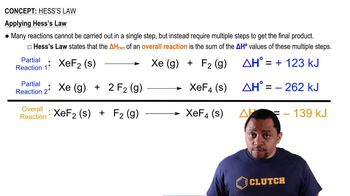
Use Hess's Law to combine the reactions: (1) and (2) as given, and the reversed (3), ensuring that the intermediates (CO2 and H2O) cancel out to yield the target reaction.
Sum the enthalpy changes of the adjusted reactions to find the ΔH° for the target reaction.

Risposta video verificata per un problema simile:

Questa soluzione video è stata consigliata dai nostri tutor come utile per risolvere questo problema.
Durata del video:
5m

Concetti chiave

Ecco i concetti essenziali che devi comprendere per rispondere correttamente alla domanda.

Hess's Law

Hess's Law states that the total enthalpy change for a chemical reaction is the same, regardless of the number of steps taken to complete the reaction. This principle allows us to calculate the enthalpy change of a reaction by using the enthalpy changes of related reactions, making it particularly useful for reactions that are difficult to measure directly.
Video consigliato:

Enthalpy (ΔH)

Enthalpy is a thermodynamic quantity that represents the total heat content of a system. It is often expressed as ΔH, which indicates the change in enthalpy during a reaction. A negative ΔH value signifies that the reaction is exothermic, releasing heat, while a positive ΔH indicates an endothermic reaction, absorbing heat.
Video consigliato:
Percorso guidato
02:34
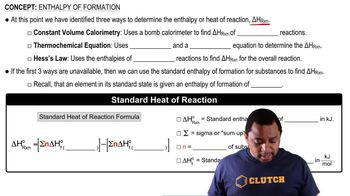
Enthalpy of Formation

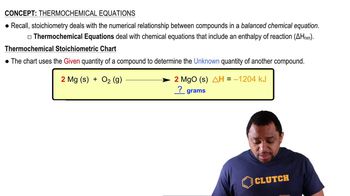
Thermochemical Equations

Thermochemical equations are balanced chemical equations that include the enthalpy change associated with the reaction. These equations provide essential information about the energy changes that occur during chemical reactions, allowing chemists to predict the heat absorbed or released when reactants are converted to products.
Video consigliato:
Percorso guidato
01:13
Thermochemical Equations