
Ch.6 - Electronic Structure of Atoms
Brown - Chemistry: The Central Science 14th Edition
Brown14th EditionChemistry: The Central ScienceISBN: 9780134414232Non è quello che usi tu?Cambia libro di testo
Capitolo 6, Problema 2b

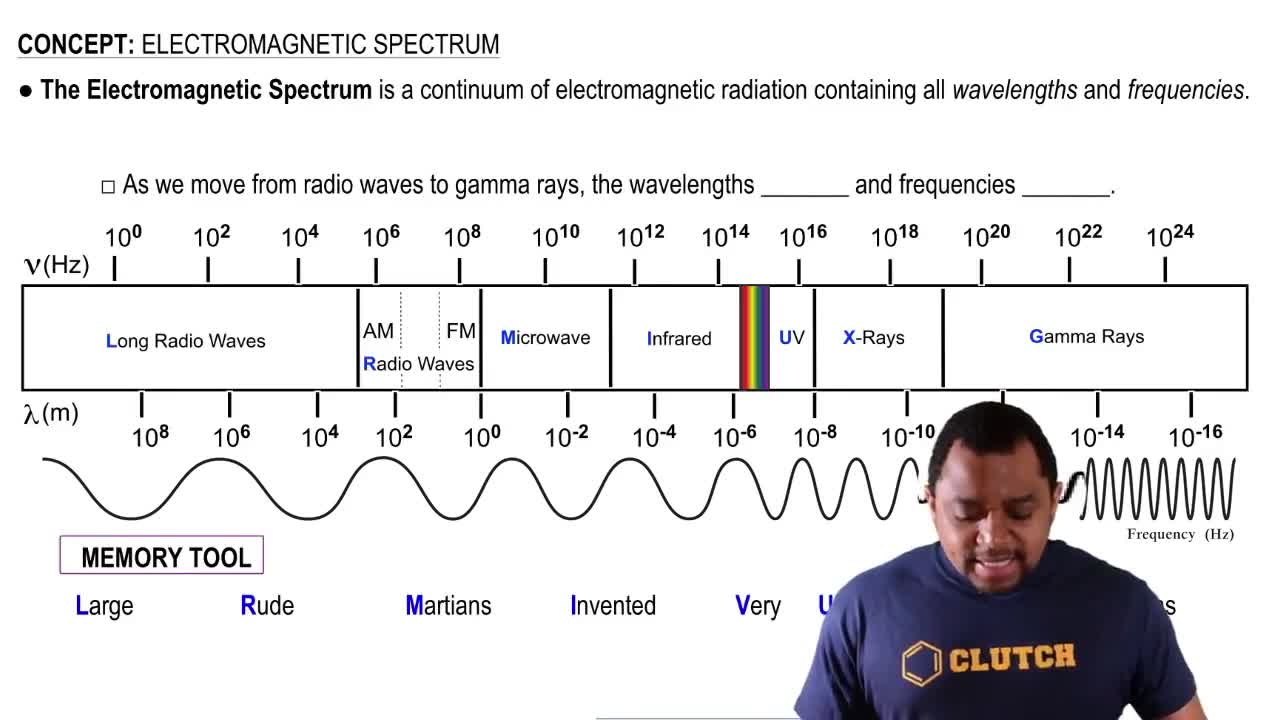
A popular kitchen appliance produces electromagnetic radiation with a frequency of 2450 MHz. With reference to Figure 6.4, answer the following: (b) Would the radiation produced by the appliance be visible to the human eye?
Diagram of the electromagnetic spectrum showing frequency ranges and visible light spectrum.

Guida verificata passo dopo passo
1
Identify the frequency of the electromagnetic radiation produced by the kitchen appliance, which is 2450 MHz.
Convert the frequency from MHz to Hz by multiplying by 10^6 (since 1 MHz = 10^6 Hz).
Locate the frequency range of the visible spectrum on the electromagnetic spectrum diagram. The visible spectrum ranges from approximately 4 x 10^14 Hz to 7.5 x 10^14 Hz.
Compare the frequency of the kitchen appliance's radiation (2450 MHz or 2.45 x 10^9 Hz) to the frequency range of the visible spectrum.
Determine if the frequency of 2.45 x 10^9 Hz falls within the visible spectrum range. If it does not, then the radiation is not visible to the human eye.

Risposta video verificata per un problema simile:

Questa soluzione video è stata consigliata dai nostri tutor come utile per risolvere questo problema.
Durata del video:
2m

Concetti chiave

Ecco i concetti essenziali che devi comprendere per rispondere correttamente alla domanda.

Electromagnetic Spectrum

The electromagnetic spectrum encompasses all types of electromagnetic radiation, arranged by frequency or wavelength. It ranges from low-frequency radio waves to high-frequency gamma rays. The visible spectrum, which is the portion detectable by the human eye, lies between approximately 400 nm (violet) and 700 nm (red). Understanding where a specific frequency falls within this spectrum is crucial for determining its visibility.
Video consigliato:
Percorso guidato
02:53
Electromagnetic Spectrum

Frequency and Wavelength

Frequency refers to the number of cycles of a wave that pass a point in one second, measured in hertz (Hz). Wavelength is the distance between successive peaks of a wave, typically measured in nanometers (nm) for light. The relationship between frequency and wavelength is inversely proportional; as frequency increases, wavelength decreases. This relationship helps to categorize electromagnetic radiation into different types, including visible light.
Video consigliato:
Percorso guidato
00:31
Frequency-Wavelength Relationship

Microwave Radiation

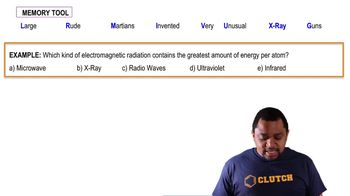
Microwave radiation is a type of electromagnetic radiation with frequencies ranging from about 300 MHz to 300 GHz, corresponding to wavelengths from 1 meter to 1 millimeter. The frequency of 2450 MHz, as mentioned in the question, falls within the microwave range. Microwaves are not visible to the human eye, as they lie outside the visible spectrum, which is essential for answering whether the radiation produced by the appliance is visible.
Video consigliato:
Percorso guidato
01:02
Electromagnetic Radiation Example